
When a listing looks far cheaper than comparable products, the useful question is not whether it is a trap. It is whether the price refers to the same product under the same transaction terms. Normalize identity and landed price first; only then do band position and contribution become meaningful.
This article is about price verification in product research, not about any specific marketplace, store, or product. All amounts, rates, conversion assumptions, and contribution figures are hypothetical examples used to show the calculation order. They are not platform quotes, customer data, or promises of return.
1. The decision: is the low price an opportunity or a different scope?
A listing priced 20%, 30%, or more below comparable products can have at least five explanations: the same product in a different pack, version, or capacity; a short-term seller or platform promotion; a lower procurement, logistics, or tax structure; a product that omits warranty, returns, or service; or a loss leader whose profit comes from another SKU.
The selection decision is therefore neither “buy because it is cheap” nor “avoid because it is cheap.” First ask whether you can reproduce that price under the same specification, site, tax, and fulfillment terms. If you cannot, it is not your cost advantage. If you can, move on to band position and contribution.
When a listing is clearly cheaper than comparable products, decide first whether it reflects a real cost advantage, a different specification, a short promotion, or a price war that will drag followers into negative contribution.
2. Mechanism: list price, reference price, landed price, and transaction price are different things
A struck-through price on a product page is usually a reference price, not the current transaction price. The current offer price is also not necessarily what the buyer pays, because shipping, coupons, member prices, taxes, and promotions may apply. The seller center's transaction, refund, and settlement records are yet another scope. Subtracting one from another often produces a “gap” that is only a definition gap.
The struck-through reference price, the current offer price, the landed price, and the seller-center transaction price come from different scopes; subtracting them directly mixes discounts, shipping, and promotions.
Amazon's official guidance defines a reference price as a benchmark that helps customers understand an offer and its savings, and distinguishes List Price from Typical Price. A List Price is the suggested retail price provided by a manufacturer, supplier, or seller, and it should represent a price at which substantial sales have recently been made or are intended. A Typical Price is computed from the median price customers paid over the past 90 days, excluding prices paid during limited-time promotions. Amazon validates these reference prices against its own sales and external competitor prices, so a seller cannot simply invent a high anchor.
The U.S. Federal Trade Commission's Guides Against Deceptive Pricing point in the same direction. If the “former” price is not a bona fide price but a fictitious anchor created to make a reduction look larger, the bargain is false. Conversely, the absence of sales at the advertised price does not by itself prove that the former price was fictitious; the question is whether it was openly and actively offered in good faith for a reasonably substantial period.
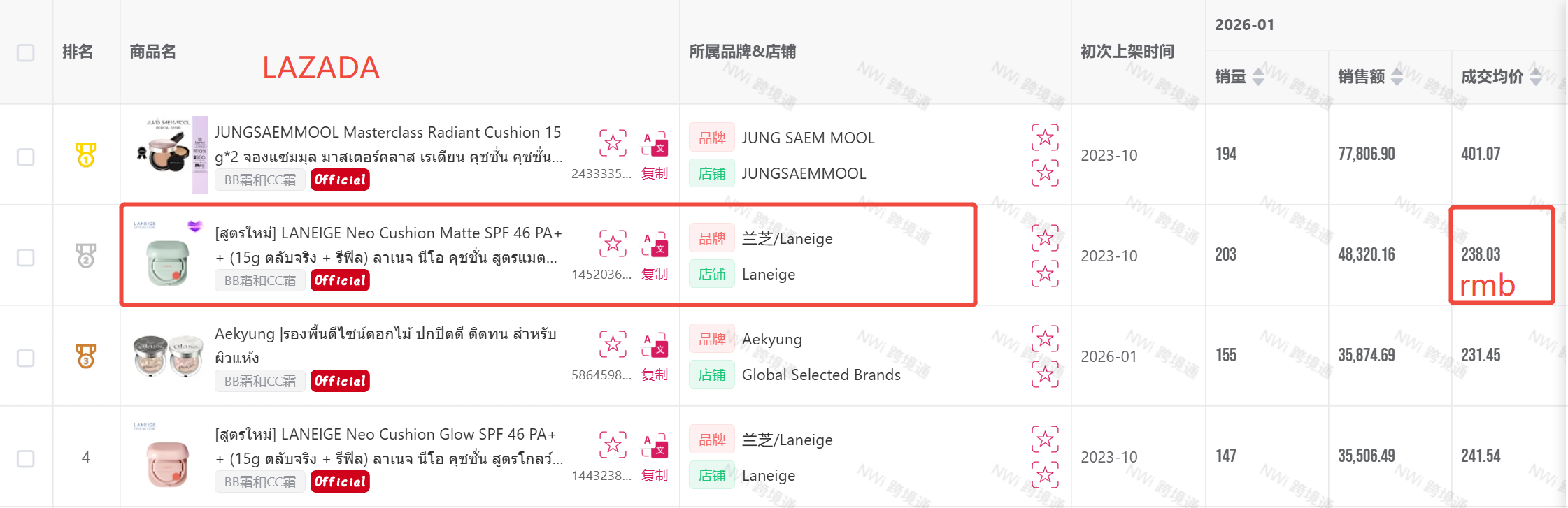
For product research, separate at least four prices: the page list or offer price, the reference or “was” price, the landed price (offer price plus shipping and required taxes minus combinable discounts), and the transaction price (what buyers actually paid, usually visible only in the seller center or platform settlement). Do not mix them, and never compare one marketplace's list price with another marketplace's landed price.
3. Five checks: from like-for-like unit price to contribution floor
Run the five checks in order. If any check reveals a scope mismatch, stop and fix it before calculating a more precise-looking number.
Check 1: confirm identity and specification
Verify brand, model, GTIN/UPC, version, color, capacity, pack count, and bundle contents. The same product image does not prove the same product, and the same ASIN can carry different bundles from different sellers. If identity differs, the price gap is a product gap, not a price advantage.
Check 2: normalize currency and landed unit price
Put the list price, shipping, mandatory platform fees, tax or duty assumptions, and combinable discounts into one table, then calculate per piece, per milliliter, per gram, or per capacity unit. Convert at the exchange rate on the observation date and record that date. Do not compare today's price with a rate from a month ago. If one marketplace shows tax-inclusive prices and another shows tax-exclusive prices, add the tax before comparing.
Check 3: test whether the reference price is verifiable
When a page says “was 29.90, now 19.90,” ask whether 29.90 was genuinely transacted or openly offered recently. Amazon's guidance says a List Price should represent recent substantial sales, and its Typical Price uses the 90-day median paid price excluding limited-time promotions; the FTC explicitly prohibits a fictitious former price used to create a false discount. If the reference price cannot be verified, treat it as page copy, not as the market price.
Check 4: read band position, not just the lowest price
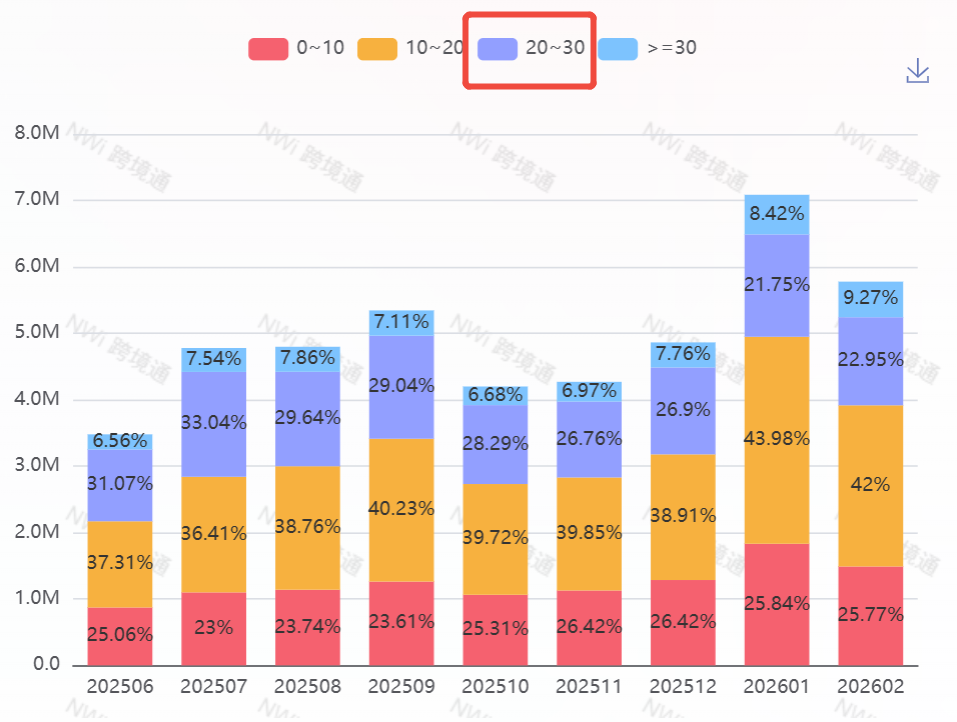
Sort comparable products on the same site, category, and specification by landed unit price, then calculate p25, median, and p75. Look at the number of products, unit or sales-value share, and brand concentration in each band. The lowest price only shows that someone is willing to sell at that price; it does not show that the band still has demand. A crowded band with a small sales share may be crowded, not attractive; a narrow band in a stable category may simply be a mature commodity structure.
NWi CrossborderGo groups products by average selling price and reports the sales-value or unit share of each band. Its public market data is estimated, updated monthly, normally covering the previous month on the 10th–15th. It is built for structure, not real-time price monitoring, and it does not provide seller-center orders, refunds, advertising, or settlement. Available sites, history, and fields depend on the activated modules and the contract.
Check 5: use the contribution floor to decide whether to match
Put price, procurement, platform commission, fulfillment, returns, and advertising reserve on the same unit basis, then calculate unit contribution. If contribution is negative at the target price, or below your own floor, matching the price is not a competitive strategy; it is scaling a loss through volume. If contribution is positive but below the floor, look for a verifiable cost reduction. If there is none, differentiate or exit instead of cutting again.
4. Evidence boundary: what platform rules, market estimates, and seller records can prove
Amazon's reference-price rules describe how Amazon validates strike-through prices in the U.S. store; they cannot be generalized to every site on Shopee, Lazada, or TikTok Shop. The FTC's rules address U.S. commercial practices and do not replace other jurisdictions' pricing laws. Definitions, display rules, and validation periods differ by platform and site, so cross-border comparisons need a site-by-site check.
Amazon's reference-price rules explain how its U.S. store validates strike-through prices; they cannot be extended to every site on Shopee, Lazada, or TikTok Shop.
Amazon's SP-API Product Pricing API provides offer-level pricing, reference prices, and competitive pricing signals for a seller's catalog, and its availability is limited to sellers. It helps with repricing and competitive-offer decisions, but it is not a cross-category, cross-marketplace transaction-price archive. Market research data, seller-center settlement records, and public page prices cannot substitute for one another.
China's Price Monitoring Regulation (NDRC Order No. 1) governs the government's monitoring of important goods and service prices. It is not a marketplace test for an “abnormal price” and not a product-selection standard. Applying a government monitoring definition to a marketplace listing creates an appearance of authority without the relevant scope; that was the core problem with the old article's misattributed regulation and order number.
NWi CrossborderGo's public market data is estimated from publicly visible prices and sales signals. It supports category, brand, band, and competitive-structure analysis; it is not marketplace financial reporting or seller settlement. Market figures in NWi Operations are also third-party estimates, suited to product research and content preparation, not real-time price monitoring. If you need higher-frequency competitor or price monitoring, confirm the fields, frequency, and sites in the contract rather than assuming that a menu entry equals a delivered capability.
5. Counter-case: a low price is not always a trap, and a narrow band is not always a dead end
A low price can also come from scale purchasing, a platform subsidy, clearance, a different pack, or a lower service level, and a narrow band can simply be the stable structure of a mature commodity.
One legitimate low-price case is a seller with stable large-volume procurement and a shorter fulfillment chain who can offer the same specification below peers for a sustained period while keeping positive contribution. Another is a platform subsidy used to acquire customers; when the subsidy ends, the price returns to normal. Treating the subsidy-period price as the long-term market price overstates your room to cut.
A cross-marketplace gap is not automatically diversion or counterfeit. Importers, duties, VAT, channel authorization, warranty responsibility, and platform commissions differ by country. The same product can show a gap simply because those conditions differ. Only after checking the authorization chain, importer, batch, and after-sales responsibility should you upgrade a gap into a channel-risk claim.
6. Two worked scenarios: unit price and contribution floor
Both scenarios are hypothetical. The numbers demonstrate the calculation order; they are not actual results for any marketplace, category, or seller.
Both scenarios state their assumptions first: compare like-for-like landed unit prices, then calculate contribution from price, procurement, commission, fulfillment, and a returns and advertising reserve.
Scenario A: the same product in different packs
Assume Offer A is USD 8.90 for one pair with USD 2.00 shipping; Offer B is USD 12.50 for two pairs with USD 2.50 shipping, and both are the same model and capacity.
A's landed price = 8.90 + 2.00 = USD 10.90 per pair. B's landed price = 12.50 + 2.50 = USD 15.00 for two pairs = USD 7.50 per pair. A's list price looks lower, but on a like-for-like landed basis B is cheaper by 10.90 − 7.50 = USD 3.40 per pair, or 3.40 ÷ 10.90 = 31.2% below A.
If B's battery capacity is only 80% of A's, normalize by capacity: A is 10.90 ÷ 100 = USD 0.109 per capacity point, and B is 7.50 ÷ 80 = USD 0.09375 per capacity point; B is still about 14.0% lower. This is why a low price only means something after specification and unit normalization. If specifications differ, stop the direct comparison and use a like-for-like sample or a capacity and performance adjustment.
A's landed price is USD 10.90 per pair and B's is USD 7.50 per pair; B is USD 3.40 cheaper, or 31.2% below A on a landed basis.
Compare like-for-like landed unit prices first; if model or capacity differs, stop the comparison and use a like-for-like sample or a capacity-adjusted comparison.
Scenario B: the contribution floor after matching a price cut
Assume a USD 19.90 price, USD 7.50 landed cost, 15% commission, USD 3.20 fulfillment, and USD 2.00 returns and advertising reserve, while a competitor moves the price to USD 16.90.
Contribution at the original price = 19.90 − 7.50 − 19.90×15% − 3.20 − 2.00 = 19.90 − 7.50 − 2.985 − 3.20 − 2.00 = USD 4.215, or 4.215 ÷ 19.90 = 21.2%. At USD 16.90, contribution = 16.90 − 7.50 − 16.90×15% − 3.20 − 2.00 = 16.90 − 7.50 − 2.535 − 3.20 − 2.00 = USD 1.665, or 1.665 ÷ 16.90 = 9.9%.
If your contribution floor is 15% of price, the floor at USD 16.90 is USD 2.535. Current contribution is USD 1.665, a shortfall of USD 0.870. If the returns and advertising reserve rises from USD 2.00 to USD 3.00, contribution falls to USD 0.665, or 3.9%. At that point matching the price is not “earning a little less”; it is removing nearly all of the unit's buffer.
Contribution at the original price is USD 4.215 (21.2%); at USD 16.90 it falls to USD 1.665 (9.9%), USD 0.870 below the assumed 15% floor.
If procurement, fulfillment, and returns costs cannot fall by a combined USD 0.87, do not match; differentiate the offer or exit the band, and review the decision for two consecutive months.
7. Action list and stop conditions
Build a like-for-like landed unit-price sheet, verify the reference price and promotion rules, then use the contribution floor to decide whether to match, differentiate, or exit.
- Build the sheet: record URL, site, observation time, currency, list price, shipping, discounts, tax assumptions, pack count, model or GTIN, seller, and stock status.
- Sample: observe the same product on at least three dates across 14 days (an assumed threshold) before calling a trend; a single screenshot only shows what the page displayed at that moment.
- Normalize: convert to per piece, per milliliter, per gram, or per capacity unit, and record the exchange-rate date; tax-inclusive and tax-exclusive prices are not directly comparable.
- Verify: check whether the reference price is supported by recent transactions or public offers; whether the promotion is time-limited or conditional; whether a cross-marketplace gap survives tax, shipping, and authorization checks.
- Calculate: use price, procurement, commission, fulfillment, returns, and advertising reserve to compute unit contribution, and run at least one sensitivity case with higher costs.
- Decide: enter a small test only if contribution meets your floor and the cost is reproducible; if it is below the floor and no cost path exists, stop matching.
Write stop conditions you can actually execute: if identity or specification differs, stop the comparison; if the reference price cannot be verified, do not treat it as the market price; if the gap disappears after tax and shipping, drop the cross-marketplace arbitrage thesis; if contribution at the target price is below the floor and no verifiable cost reduction exists, stop or exit; if the price change is confirmed as a limited-time platform promotion, do not treat it as a structural low price.
8. Limitations: what we still do not know
Public pages do not show transaction prices, personalized prices, or the real allocation of returns and advertising, and exchange rates, taxes, and platform fees vary by site and contract.
- Prices can differ by login state, region, membership tier, coupon, and new-customer subsidy; a publicly captured price may not be what you or a buyer sees.
- Platform reference-price rules change and differ by site; the Amazon rules cited here cover only their stated scope and do not replace a site-by-site policy check.
- Band shares are based on estimated average selling prices, not audited transactions; product counts, unit share, and brand concentration must be read together.
- Procurement, fulfillment, returns, and advertising inputs in the contribution model are assumptions; real values come from the seller's own contracts, invoices, and seller-center data.
- With a small sample, a short observation window, or strong seasonality, a few products or a short promotion can distort the distribution and the trend.
These unknowns do not disappear by adding decimal places. Write them down as assumptions, record the source and date, and recalculate when seller-center data is available. Do not present an assumption as a measurement, or a platform estimate as settlement.
9. What this adds: from price shapes to an executable decision
The contribution here is to replace five alarming price shapes with one repeatable order: identity, landed unit price, reference-price validity, band position, and contribution floor.
This order does not promise that a low price always works or never works. It turns the question into verifiable conditions: is it the same product, what is the unit price, is the reference price genuine, does the band have demand, and is there contribution left at that price. If any condition fails, the conclusion should be stop or revise, not “it feels cheap, so continue.”
If you already have a candidate category, the next step is not another dramatic screenshot. Put 20–30 like-for-like products from the same site into one table, sort by landed unit price, mark p25, median, p75, and the contribution floor, then check the structure against NWi CrossborderGo's band share and brand concentration. To view category, site, and band on one consistent scope, open the [NWi CrossborderGo product page](/product/); to walk through a real category and two competitors in a 15-minute demo, use the [demo request](/demo/). For product research and content preparation, see [NWi Operations](/products/zhiying/); its market figures are also third-party estimates, not real-time price monitoring.
10. Sources and method
Method: this article normalizes specification, currency, shipping, and tax before calculating landed unit price and unit contribution. All scenarios are hypothetical and are not quotes, return promises, or statements of platform policy.
Disclosure: this article was prepared with automated research assistance by NWi Content Research from the Amazon documents, U.S. Federal Trade Commission regulation, and Chinese State Council Gazette regulation listed below. It was not reviewed by a human editor. It does not invent customer data, expert review, ranking effects, or platform endorsement.
- 1. Amazon Selling Partner Blog, “Engage customers with an Amazon List Price” (primary, 28 October 2025): definitions and validation logic for reference price, List Price, Typical Price, and offer price; read the original, accessed 27 November 2026.
- 2. Amazon Selling Partner API, “Product Pricing API” (primary, page updated 9 September 2026): offer-level pricing, reference prices, and competitive pricing signals; sellers only; read the original, accessed 27 November 2026.
- 3. U.S. Federal Trade Commission, “Guides Against Deceptive Pricing,” 16 CFR Part 233 (primary regulation; eCFR current as of 24 November 2026; originally published 8 November 1967): former-price comparisons and fictitious former prices; read the original, accessed 27 November 2026.
- 4. China State Council Gazette, “Price Monitoring Regulation (NDRC Order No. 1)” (primary, promulgated 9 April 2003, effective 1 June 2003): government price monitoring of important goods and services, not a marketplace price-anomaly test; read the original, accessed 27 November 2026.