
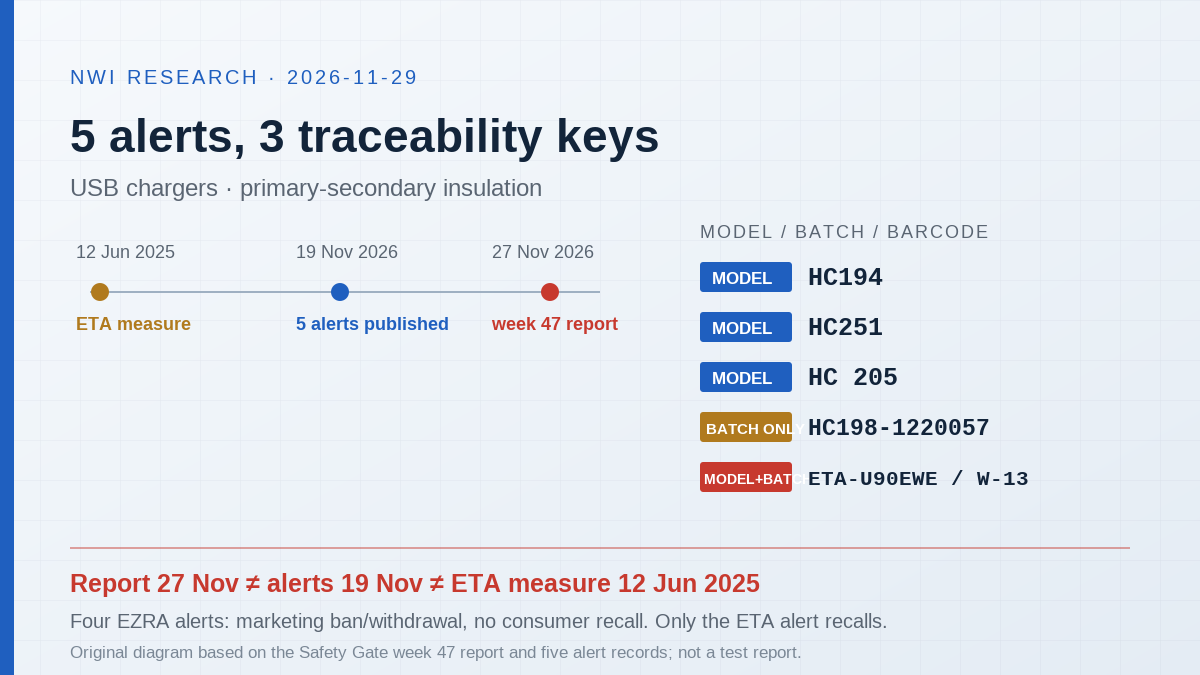
If you sell USB chargers, wall chargers or travel adapters in the EU, the decision is not “five more chargers were recalled.” It is which of the five alerts can be tied to a model, which only to a batch, which actually includes a consumer recall, and whether to retest by model or stop the whole group. The week 47 report was published on 27 November 2026, but the four EZRA alerts were published on 19 November and the ETA adapter’s measure entered into force on 12 June 2025. Mixing those dates produces the wrong stop-sale scope.
This article is for three kinds of seller: a charger seller on Amazon EU or another EU marketplace, an importer that places chargers on the EU market, and a distributor supplying either. A seller with different models and checkable model and batch records should not stop the whole line because the product is a USB charger. Continuing to sell a named model or batch after an official alert is much harder to defend.
1. Three traceability keys behind five alerts
| Alert | Product | Model | Barcode | Batch | Measure | Online sales |
|---|---|---|---|---|---|---|
| SR/03373/26 | EZRA CHARGING SET | HC194 | 6988012200646 | None | Compulsory marketing ban (distributor) | Not sold online |
| SR/03372/26 | EZRA POWER CHARGER 35W | HC251 | 6918033874946; 6988012201414 | None | Compulsory withdrawal (distributor) + marketing ban (other operator) | Not sold online |
| SR/03367/26 | EZRA 65W MAX / FAST CHARGER | HC 205 | 6988012200769 | None | Compulsory withdrawal + marketing ban (distributor) | Not sold online |
| SR/03366/26 | EZRA POWER CHARGER 45W | No model code | 6988012200578 | HC198-1220057 | Compulsory withdrawal (importer) + marketing ban (distributor) | Not sold online |
| SR/03371/26 | Travel Adapter | ETA-U90EWE; W-13 | 5697491110131 | YE21010 | Compulsory withdrawal + recall + marketing ban (distributor) | Unknown |
The important number is not five; it is three traceability keys. The first three EZRA alerts name models HC194, HC251 and HC 205 but give no batch number. The fourth EZRA alert, a 45W charger, has no model code (the official field typeModelKnown is false) and is identified only by barcode 6988012200578 and batch HC198-1220057. The fifth alert, an ETA travel adapter, has models ETA-U90EWE/W-13 and batch YE21010. Each key supports a different stop-sale scope: by model, by batch, or by model plus batch.
The real decision is which of the five alerts can be tied to a model, which only to a batch, which has no consumer recall, and whether to retest by model or stop the group.
Measures differ too. The four EZRA alerts carry a compulsory marketing ban and/or withdrawal, but no consumer recall. Only the ETA alert combines withdrawal, recall and a marketing ban. Under Article 2 of the Low Voltage Directive (LVD), withdrawal prevents equipment in the supply chain from being made available, while recall aims to return equipment already with end users. They are not the same action: no recall does not mean purchased units return to the warehouse by themselves; a recall does not mean every seller has completed refunds.
Dates differ. All five alerts were published on 19 November 2026; the weekly report is dated 27 November 2026; the ETA measure entered into force on 12 June 2025. The report is a compilation, not a single-day event; it brings together alerts of different dates and measures. It is not “five new recalls on 27 November.” Treating the report date as the alert date turns a 2025 ETA measure into a new event; treating the alert date as the measure date understates how long EZRA sellers may have kept selling after 19 November.
One field is not a marketplace status: the four EZRA records say “not sold online”; the ETA record says “unknown.” That is the notifying country’s assessment of the sales channel, not a platform delisting receipt; no marketplace, seller or store is named. Reading “not sold online” as “the platform has already removed it” is an overreach.
2. Mechanism: why “it still charges” is not proof of insulation
A USB charger converts mains voltage on the primary side into a low-voltage output on the secondary side. The primary side connects to 220–240 V mains; the secondary side reaches the phone or laptop through the USB port and cable. Enough insulation, creepage distance and clearance must separate the two, or mains voltage can reach the USB port.
The product lacks adequate insulation between the primary and secondary circuits; the USB ports and connected cable can become live under mains voltage, and the user may receive an electric shock. That is the alert’s wording. It also says the product does not comply with the Low Voltage Directive or EN 60335-1.
A common misread follows: if it powers a phone, the low-voltage output works; that proves nothing about primary-secondary insulation. A failure can appear only under no-load, humidity, enclosure pressure, cable bending or a production-batch consistency problem. A visual check, a power-on test and “it worked for months” cannot replace a dielectric-strength, creepage and clearance measurement. The alert publishes no measured values and no test report, so it establishes an official finding of non-compliance, not how narrow the margin was.
The legal chain matters. LVD Article 3 requires equipment not to endanger health or safety when properly installed, maintained and used. Article 12 gives a presumption of conformity only for harmonised standards whose references are published in the Official Journal of the EU. Article 8 requires importers to ensure, before placing equipment on the market, that the manufacturer carried out the conformity assessment, that technical documentation exists, and that the CE marking and required documents accompany the product. A CE mark and a supplier declaration are entry documents, not an insulation test report for a specific model or batch.
For a seller, the mechanism-level conclusion is: prove that this model or batch has adequate primary-secondary insulation, not that the charger still works. The evidence gap between those two statements is a test report.
3. Evidence boundary: what the five records do not say
- There is no sales, inventory, import-volume, market-share or denominator data. The 110 weekly-report notifications, 8 electrical records and 5 USB chargers are counts of alert records, not a failure rate or a measure of market prevalence.
- The first three EZRA alerts give no batch number, so only brand plus model is traceable; the 45W record has a batch but no model code, so only barcode plus batch is traceable; do not treat the four EZRA entries as one shipment.
- The ETA record has both model and batch, but its measure entered into force on 12 June 2025. It is not a recall that took effect on 27 November 2026 and cannot be used to imply a new charger recall wave in 2026. The records do not explain why the measure took effect in 2025 but the alert was published in November 2026; the gap alone is not evidence of a new violation.
- The four EZRA records say “not sold online”; the ETA record says “unknown.” No marketplace, seller or store is named, and the records do not say any listing was removed. The field is not a platform receipt.
- The records publish no creepage, clearance or dielectric-strength measurements, no test report, no injury count and no incident report. They establish an official finding of non-compliance, not the size of the margin.
- The weekly report is a compilation of notifications, not a market-surveillance sample. It does not prove that other models, other batches or other travel adapters from the same brand fail.
Those boundaries mean this article cannot give you a failure rate for these chargers or say that every EZRA charger must stop. It can give you three traceability keys, a test scope, a stop order and stop conditions.
4. Counter-cases: which chargers should not be delisted
- Counter-case one: stop every EZRA charger with a model code. The first three alerts name HC194, HC251 and HC 205, but other models of the same brand are not in the alerts. If another model has a complete EN 60335-1 report and checkable insulation measurements, it may be treated as outside the named scope instead of stopping the brand.
- Counter-case two: because the 45W entry has only a batch, stop every 45W charger. Batch HC198-1220057 is the only traceable key; unless the same insulation construction is shown to be shared, a batch stop is more accurate than a model stop.
- Counter-case three: treat the ETA’s 2025 measure as a new 2026 recall and stop every travel adapter. The measure predates the weekly report by more than a year and is scoped to models ETA-U90EWE/W-13 and batch YE21010; do not widen it without evidence.
- Counter-case four: relist a named model because the supplier sends a CE certificate, a declaration of conformity or another model’s test report. A CE certificate and DoC are entry documents, not an insulation test for this model; another model’s report does not cover a different transformer, enclosure or PCB layout.
- Counter-case five: use “it charges,” “the case looks fine” or “it worked for six months” as proof of insulation. These observations do not measure creepage, clearance or dielectric strength and cannot replace a test report.
The core counter-case is not “be cautious”; it is “do not stop every model of the same brand without evidence.” These counter-cases are not reasons to keep selling; they decide which key you stop first and which document you request. A supplier that can match model, batch, barcode and test report is the only one worth discussing relisting with.
5. Scenario A: four EZRA entries, 1,200 units
Scenario A: four EZRA entries, 1,200 units, test or stop the group
Assumptions: four EZRA entries of 300 units each, 1,200 units in total; 75 sold and 225 in stock per entry; unit cost EUR 6; net refund/recall cost EUR 12 per sold unit; test cost EUR 350 per entry; platform commissions, advertising, penalties, lost sales and supplier compensation are excluded.
Result: A blanket stop of four entries costs 900 × 6 + 300 × 12 = 5,400 + 3,600 = EUR 9,000; testing all four costs 4 × 350 = EUR 1,400. If one entry fails, failure handling costs 225 × 6 + 75 × 12 = 1,350 + 900 = EUR 2,250; adding the four tests gives EUR 3,650. If all four pass, the spend is EUR 1,400 and the stock can be relisted. One test fee of EUR 350 equals 15.6% of that entry’s EUR 2,250 stop exposure.
Decision: quarantine and test by entry; relist only after a pass, and handle only the failing entry rather than scrapping all four. If the supplier cannot bind the report to the model or batch, the EUR 1,400 buys no traceable conclusion; in that case stop by entry, not by the whole group.
The EUR 9,000 is not a net profit loss; it is the combined stop handling and inventory write-down, before the 75 units already paid for, platform commissions, advertising, penalties and supplier compensation. Treating it as a net loss overstates the hit; treating it as the full cost understates the cash pressure from refunds and return logistics.
6. Scenario B: five entries, 1,000 units
Scenario B: five entries, 1,000 units, test all or only the two batched entries
Assumptions: five entries of 200 units each, 1,000 units in total; 40 sold and 160 in stock per entry; unit cost EUR 6; net refund/recall cost EUR 12 per sold unit; test cost EUR 350 per entry; platform commissions, advertising, penalties, lost sales and supplier compensation are excluded.
Result: A blanket stop of five entries costs 800 × 6 + 200 × 12 = 4,800 + 2,400 = EUR 7,200; testing all five costs 5 × 350 = EUR 1,750. If one entry fails, failure handling costs 160 × 6 + 40 × 12 = 960 + 480 = EUR 1,440; adding the five tests gives EUR 3,190. Testing only the two batched entries costs 2 × 350 = EUR 700; stopping the three model-coded EZRA entries without a batch costs 3 × 1,440 = EUR 4,320, for a total of EUR 5,020. Testing all five is EUR 3,270 lower than testing only the batched entries and stopping the other three. That difference assumes all five pass; if one fails, the all-test total is EUR 3,190, which is EUR 1,830 lower than EUR 5,020.
Decision: test the three model-coded EZRA entries by model, the 45W by batch HC198-1220057, and the ETA by batch YE21010. Do not use “only test what has a batch” to save test fees; it leaves the three model-coded EZRA entries without a conclusion.
The difference between the scenarios is not whether to act; it is how wide the action is and whether testing can restore a listing. A compares the four EZRA entries as a group; B compares testing every entry with testing only the batched two. Units, costs and prices are assumptions in both; change any input and recalculate with the same formulas. Do not treat the EUR 3,650 or EUR 3,270 as an actual loss.
7. Action list and stop conditions
Five actions you can take now:
- Build the SKU map: brand, model, barcode, batch, stock and sold units on one line. Use the model for the first three EZRA entries, batch HC198-1220057 for the 45W, and model ETA-U90EWE/W-13 plus batch YE21010 for the ETA.
- Request the report: ask the supplier for the EN 60335-1 report and key measurement pages tied to the model or batch, covering at least primary-secondary insulation, creepage and clearance. Do not accept only a CE certificate, a DoC or a general “all products conform” letter.
- Quarantine first: before results, stop and isolate HC194, HC251 and HC 205 by model, and HC198-1220057 and YE21010 by batch. Do not treat “not sold online” as proof that the marketplace has removed the listing.
- Act on the result: relist only after a pass and keep the report; if an entry fails, handle only that model or batch, not every USB charger.
- Trace the construction: if the supplier cannot provide a model-specific report, stop buying that model. If the same enclosure, transformer or PCB layout is used in other models, extend the test scope to the shared construction.
Quarantine by model or batch, request the EN 60335-1 report, and relist only after the test passes.
Restore a named model or batch only when all of these hold: the report matches the model, batch and barcode; the report uses the current harmonised-standard edition; the laboratory and method can be checked; the authority or marketplace has not widened the alert; and no new injury or incident report points to the same model or batch. If one condition is missing, keep the stop and do not replace documents with “the supplier says it is fine.”
Widen the quarantine and escalate if any of these occurs: the supplier cannot produce a model or batch report; the official alert widens the model or batch scope; a marketplace or regulator asks questions or delists; an injury or incident report is linked to the model or batch; or the same model or batch is alerted in another market with a wider scope. At that point, stop calculating the cost of a narrow stop and isolate the worst case first.
If you never carried any of the five models or batches, the correct action is to keep records: purchase invoices, model and batch photos, supplier reports and the inspection record for the day. Keep watching the official alerts. Do not issue an “our products are absolutely safe” statement, and do not turn “we never stocked it” into “it passed testing.”
8. What this means for product selection and data
The selection lesson is not “do not sell USB chargers.” It is “do not sell a charger whose model and batch evidence you cannot produce.” Compliance evidence belongs in SKU admission and replenishment decisions, not in a scramble after a customer complaint or a marketplace inquiry.
Within activated modules, NWi CrossborderGo lets a team select marketplace, site, category and month, review sales value, volume, average price, product count, store count and new products, and move into brand, store and product research. Public market data updates monthly, usually between the 10th and 15th for the prior month; available sites, fields and history depend on account access and the contract. It can help size the charger category, price bands and SKU sales exposure so a team can decide which models to test first and which batches to quarantine. It does not test chargers, read EN 60335-1 reports, confirm marketplace listing status, trace batches or execute recalls.
To size the EU charger category, its price bands and SKU exposure, see NWi CrossborderGo; to discuss putting model, batch, stock and stop-sale actions into an operations workflow, book a demo. Product capabilities, site coverage and fields depend on the modules activated and the contract.
9. Method and disclosure
Data basis: on 29 November 2026 this article reopened the European Commission Safety Gate week 47 weekly report XML (report_date 27/11/2026, report_week 47), parsed all 110 notifications and counted 8 under Electrical appliances and equipment, with entries 65–69 being five USB chargers. It reopened the five alert JSON records (10119781, 10119784, 10119785, 10119786, 10119788) and checked the notifying country (Hungary), publication date (19 November 2026), model, barcode, batch, measure type and online-sales field. Legal context was read in the consolidated LVD 2014/35/EU text (Articles 2, 3, 8 and 12) and the European Commission’s LVD page. The five alerts and the weekly report are one official data lineage, not independent corroboration; the LVD text supports the legal mechanism, not the finding that these five units failed. Calculation basis: Scenario A uses 5,400 = 900 × 6; 3,600 = 300 × 12; 9,000 = 5,400 + 3,600; 1,400 = 4 × 350; 1,350 = 225 × 6; 900 = 75 × 12; 2,250 = 1,350 + 900; 3,650 = 1,400 + 2,250; 15.6% = 350 ÷ 2,250. Scenario B uses 4,800 = 800 × 6; 2,400 = 200 × 12; 7,200 = 4,800 + 2,400; 1,750 = 5 × 350; 960 = 160 × 6; 480 = 40 × 12; 1,440 = 960 + 480; 3,190 = 1,750 + 1,440; 700 = 2 × 350; 4,320 = 3 × 1,440; 5,020 = 700 + 4,320; 3,270 = 5,020 - 1,750; 1,830 = 5,020 - 3,190. All inventory, retail, cost, test, refund/recall and unit figures are labeled assumptions, not measurements by Safety Gate, the European Commission, NWi or any seller. Product boundary: within activated modules, NWi CrossborderGo provides platform, site, category, brand, store and product data to size the charger category, price bands and SKU sales exposure and to rank models and batches for testing and stop-sale work; it does not test chargers, read or issue EN 60335-1 reports, trace batches, confirm marketplace listing status, execute recalls or provide legal/compliance conclusions, and available sites, history and fields depend on account access and the contract.
This article was prepared with automated research assistance from the public sources listed at the end and has not been reviewed by a human. It does not invent customer data, expert review, test results, platform actions or ranking effects. It is not legal, compliance, product-safety or marketplace-operations advice. Whether a specific product is in scope, should be stopped, recalled or retested, which market applies, and how to communicate with an authority or marketplace should be checked against the latest Safety Gate records, the LVD and EN 60335-1 texts, an accredited test laboratory, a lawyer and the competent authority. Public-source analysis is not a market-wide test report.
This article has no seller inventory, orders, refunds, supplier contract, test report or marketplace delisting notice, and no follow-up decision from an EU authority; the five alerts are official records, not an NWi test. Every scenario figure is an assumption, not an actual loss, test fee or recall cost.
10. Conclusion
Three sentences. First, the week 47 report of 27 November 2026 is a compilation; the five USB charger alerts were published on 19 November 2026 and the ETA measure entered into force on 12 June 2025, so do not write the report date as a new recall date. Second, the five alerts carry three traceability keys: three EZRA entries have a model but no batch, one EZRA 45W has a batch but no model, and the ETA has both; only the ETA includes a consumer recall. Third, quarantine by model or batch and request the EN 60335-1 report, then relist only after a pass; do not use “stop the group” in place of scope analysis, and do not use a CE certificate or “it charges” as insulation evidence.
The contribution is threefold: separate the report date, alert date and measure date; separate model, batch and model-plus-batch keys; and use two reproducible scenarios to show the cash exposure of testing to relist versus a blanket stop. This article cannot decide whether a specific model or batch is in scope, and it does not replace a test laboratory or a competent authority.
Sources
- European Commission Safety Gate, 27 November 2026, week 47 weekly report XML: report_date 27/11/2026, report_week 47, 110 notifications; 8 under Electrical appliances and equipment, with entries 65–69 being five USB chargers.
- European Commission Safety Gate, 19 November 2026, EZRA HC194 alert 10119781: model HC194, barcode 6988012200646, no batch; compulsory marketing ban (distributor); not sold online.
- European Commission Safety Gate, 19 November 2026, EZRA HC251 alert 10119784: model HC251, barcodes 6918033874946 and 6988012201414, no batch; compulsory marketing ban (other operator) and withdrawal (distributor).
- European Commission Safety Gate, 19 November 2026, EZRA HC 205 alert 10119785: model HC 205, barcode 6988012200769, no batch; compulsory withdrawal and marketing ban (distributor).
- European Commission Safety Gate, 19 November 2026, EZRA 45W alert 10119786: official field typeModelKnown false, no model code; barcode 6988012200578, batch HC198-1220057; compulsory withdrawal (importer) and marketing ban (distributor).
- European Commission Safety Gate, 19 November 2026, ETA travel adapter alert 10119788: models ETA-U90EWE and W-13, batch YE21010, origin China; compulsory withdrawal, recall and marketing ban (distributor), entry into force 12 June 2025; online sales unknown.
- EUR-Lex, consolidated text of 30 May 2026, Directive 2014/35/EU (LVD): Articles 2(11) and 2(12) define recall and withdrawal, Article 3 sets safety objectives, Article 8 sets importer obligations, and Article 12 sets the presumption of conformity for harmonised standards.
- European Commission, Low Voltage Directive page: the LVD covers electrical equipment rated 50–1,000 V AC or 75–1,500 V DC, including power supply units; only harmonised standards cited in the OJEU give presumption of conformity.