
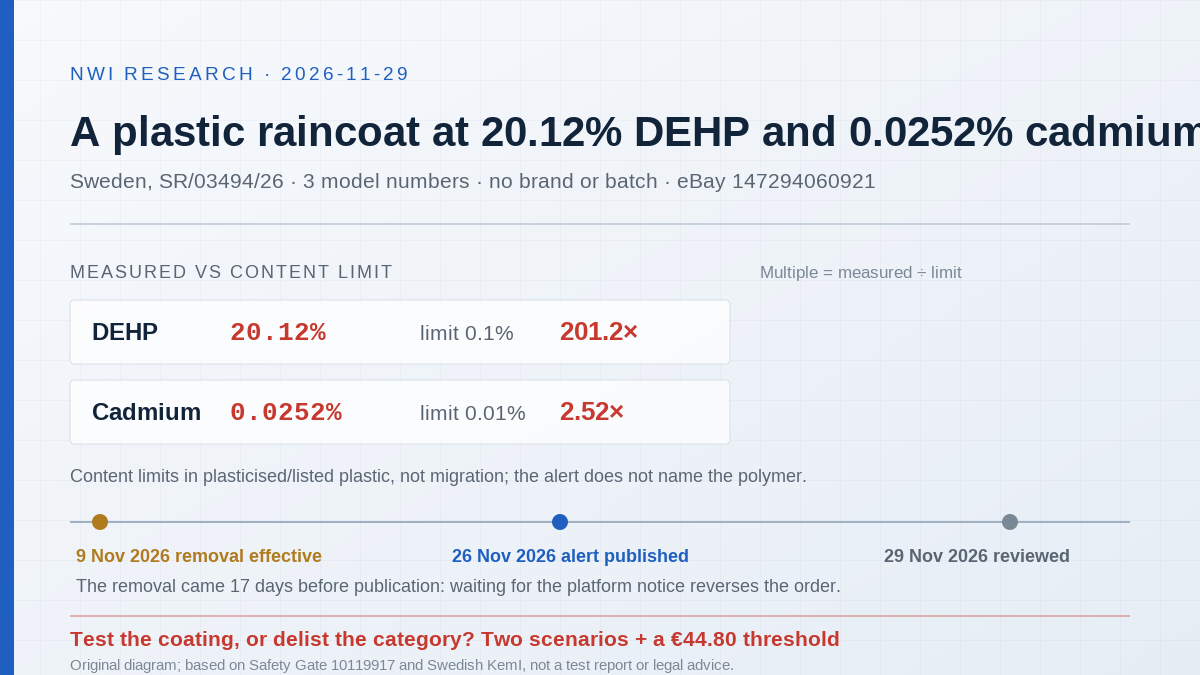
If you sell plastic-coated rainwear, coveralls or ponchos in the EU or Northern Ireland, the real decision is whether to test the three named models and their coatings first, or delist the whole rainwear category; whether to act on one eBay listing, or widen by material and supplier to other colours, sizes and shops. The alert was published on 26 November 2026, but the removal took effect on 9 November — waiting for the platform notice reverses the order.
What the alert actually says: three models, one eBay link, two dates
EU Safety Gate record SR/03494/26 was notified by Sweden and published on 26 November 2026. The product is “Unisex Adults Raincoat Zipper”, with the version name “Plastic coverall” and a description of a plastic raincoat coverall with a zip and hood, packed in a textile bag. Origin is China; it was sold online; the structured risk type is “environment (ENVIRONMENT)”.
| Field | Alert record |
|---|---|
| Product | Unisex Adults Raincoat Zipper; version name Plastic coverall (plastic raincoat coverall with zip and hood) |
| Notifying country / reference | Sweden / SR/03494/26 |
| Published / measure effective | 2026-11-26 / 2026-11-09 |
| Brand / models | No brand / 1090-06121127, 10991086, G18-403 |
| Batch / barcode | Not provided / not provided |
| Sold online / marketplace ID | Yes / eBay 147294060921 |
| Measure | Voluntary removal from the online marketplace by the distributor |
| Measured values | DEHP up to 20.12%; cadmium up to 0.0252% by weight |
| Legal basis / risk type | REACH / environment (ENVIRONMENT) |
Three gaps matter more than the numbers: no brand, only three model numbers; no batch number or barcode; the only marketplace identifier is eBay listing 147294060921. The measure is a voluntary removal by the distributor, effective 9 November 2026 — 17 days before publication. Platform removal and official publication are not the same event; waiting for the alert misses units already sold.
The risk description says the plastic material contains excessive DEHP and cadmium; DEHP may damage the reproductive system, and cadmium accumulates and can damage the kidneys and bones and may cause cancer. The structured risk type, however, is “environment”. Do not turn “environmental risk” into proven human harm, and do not delete the health language from the description.
The alert has no brand, batch or barcode, only three model numbers and one eBay listing; it cannot prove that other colours, sizes, batches or the same supplier's other SKUs are over the limit.
The risk sits in the plastic material, not in “rainwear fabric”
The useful signal is not the category “raincoat” but the material “plastic”. KemI's 2025 e-commerce inspection, published in 2026, offers a workable split: only 1 of 49 textile goods exceeded limits, while phthalates and SCCPs in soft plastic were common failures. A polyester rain shell and a plastic-coated coverall are not the same screening problem.
DEHP is a plasticiser for soft plastic and cadmium can be present in PVC and other plastics; both limits are content in the material, not migration or exposure. That is why the material deserves screening before the fabric.
REACH Annex XVII entry 51 restricts DEHP/DBP/BBP/DIBP in plasticised material to below 0.1% by weight for articles placed on the market after 7 July 2020; entry 23 restricts cadmium in listed plastics, including PVC, to below 0.01%. Both are content limits in the material, not migration or exposure limits.
Entry 51 has an exemption for articles used exclusively in industry, agriculture or outdoors, but only if no plasticised material contacts mucous membranes or remains in prolonged skin contact. A hooded coverall with cuffs and a zip is worn on the body; “it is used outdoors” does not satisfy the proviso. That is a reading of the text, not a legal conclusion; apply it with counsel or the authority.
The alert does not name the polymer. Calling it a “PVC raincoat” is seller shorthand, not an official finding; if the plastic is not one of the polymers listed in entry 23, the 0.01% cadmium limit needs separate analysis. Every later reference to “PVC screening” is an assumption, not an alert fact.
How far 20.12% and 0.0252% sit from the limits
Against entry 51's 0.1%, 20.12% ÷ 0.1% = 201.2 times the limit. Against entry 23's 0.01%, 0.0252% ÷ 0.01% = 2.52 times. Both are measured values from one alert record, not a category average or a market failure rate.
The multiple supports “far above the limit”; it does not support “every colour, size and batch is over the limit”. The record gives no sample count, test method, migration conditions or full report — only a conclusion and two maxima. Treating 201 times as proof for all rainwear over-reaches; dismissing it because “only one sample” also misses that the authority acted on it.
Separate content from migration. 20.12% DEHP says the formulation used a large amount of plasticiser; it does not say 20.12% enters the body. But entry 51 is a content restriction, so compliance does not require proof of harm. “No customer complaints” is not a rebuttal to a content finding; the two sit on different planes.
Scenario A: six SKUs, 18 samples — test first or delist all
Scenario A: six coated-rainwear SKUs in three colours — test first or delist all
Assumptions: 6 SKUs x 3 colours = 18 samples at €120 per combined DEHP+cadmium test; the three named models have 900 units in stock and 300 sold, unit cost €12, per-unit recall/refund handling €8; the other three SKUs have 900 units in stock and 300 sold; platform fees, advertising, fines and lost sales traffic are excluded.
Result: testing = 18 x €120 = €2,160; if the three named models fail, failure handling = 900 x €12 + 300 x €8 = €13,200, total €15,360; if all pass, only €2,160. Delist-all = 1,800 x €12 + 600 x €8 = €26,400. Testing saves €11,040 in the failure case and €24,240 if all pass.
Decision: quarantine the three named models and the stock behind the eBay listing while sampling the other SKUs by colour/coating; do not wait for a platform notice, and do not use one old report to cover every colour. Restore only after a pass; if a model or coating fails, act on that scope only. The delist-all figure treats the stock as a write-down plus sold-unit handling, a worst-case cash exposure; if the stock is tested and relisted, the actual loss is below €26,400, and the article does not treat it as a certain loss.
Scenario B: coating test or whole-garment test
Scenario B: coating test or whole-garment test — can the supplier break down components?
Assumptions: 2 suppliers, 4 styles, 2 colours each = 8 samples; whole-garment test €180 each, coating-only test €90 each; supplier A can provide a three-line material list (coating, print, zip), supplier B cannot; sampling, logistics and lost sales are excluded.
Result: the separable path = 8 x €90 = €720; the non-separable path = 8 x €180 = €1,440, a €720 difference. If the separable path finds one coating failure, the scope can be limited to the coating batch; the whole-garment path can only stop at garment level, a wider scope. A whole-garment pass does not prove every colour or component passes.
Decision: ask both suppliers for the material list and coating batch first; test by coating where separable, by garment where not. Do not treat a whole-garment pass as a pass for every colour/coating, and do not use a coating pass to replace testing the zip, print and soft-plastic components.
When delisting all becomes cheaper: the €44.80 threshold
Under Scenario A, testing plus handling the three named models costs €2,160 + €13,200 = €15,360, still below the €26,400 cost of delisting all. Set the per-sold-unit handling cost to h: €2,160 + €10,800 + 300h = €26,400, so 300h = €13,440 and h = €44.80. Only when handling exceeds about €44.80 per sold unit does delisting all become cheaper than testing and handling the named models.
This threshold compares only the three named models; it excludes the cost if the other three SKUs also fail, and it excludes platform penalties, regulatory fines, lost traffic and brand damage after a missed batch. The point is that the €2,160 test fee is not the main cost. What decides the direction is whether the test can be tied to the batch on sale, and how expensive a miss is.
If the supplier cannot trace the batch, the sample and the units on sale do not match, and €2,160 buys a conclusion that cannot release stock. In that case, widening quarantine by supplier/coating is more defensible than continuing to sell.
Counter-cases: not every raincoat should be stopped
The core counter-case is not caution; it is refusing to stop every model, colour and component of the same brand without evidence.
- Counter-case 1: treating every raincoat as PVC. PU, polyester coatings or unplasticised materials may not contain the restricted phthalates; but “PVC-free” is not “phthalate-free”, and “phthalate-free” is not “cadmium-free”. Each claim needs its own test evidence.
- Counter-case 2: applying an adult-raincoat conclusion to children's rainwear. Age group, contact pattern and applicable rules can differ; do not copy the adult evidence requirement to a children's product.
- Counter-case 3: one report covering every colour. Different colours, sizes or suppliers of the same model may use different coating formulations; the report must name the colour, size, component and batch.
- Counter-case 4: looking only at the coating, not the zip, print and packaging. The alert says “plastic material”; soft-plastic components, plastic prints and the packaging bag can all be screening targets, but do not condemn every component without evidence.
- Counter-case 5: restoring because the supplier sent a CE certificate, DoC or a generic “REACH compliant” letter. These are document entry points, not batch-matched DEHP/cadmium tests; without batch and component scope they cannot release stock.
- Counter-case 6: assuming the market is clear because the eBay listing was removed. KemI's inspection found that goods reported to Safety Gate often remain available in the EU; one removed listing does not mean other shops, platforms or colours are down.
Action list and stop conditions
- Build an SKU/material table: model, colour, coating/print/zip supplier, stock/sold, price and contribution; flag the three named models and eBay 147294060921 separately.
- Request reports: batch-matched coating formulation, DEHP/cadmium test reports, batch traceability and REACH conformity documents; reports must cover colour, size and component.
- Quarantine first: before results, stop/isolate the three named models and the stock behind the eBay listing; prepare a buyer notification/refund plan for sold units; do not wait for a platform notice.
- Sample the remaining SKUs by coating/colour; test by coating where components are separable, by garment where not; do not use one sample unit to represent the batch.
- Restore only when batch-level testing passes and the report matches the goods; without batch traceability, widen to the same supplier/coating.
Quarantine the three named models and the stock behind the eBay listing, sample the remaining SKUs by colour and coating, and restore only when batch-level testing passes and the report matches the goods.
Stop conditions: no batch traceability; a report older than the coating/formulation change; a report covering only another colour/size; measured DEHP/cadmium above the limit; or a platform removal while other shops still sell and the batch cannot be proven. Any one of these means do not restore.
Unknowns and limits
- NWi did not test for phthalates or cadmium and has no seller inventory, sales, order, refund or delisting data; the alert gives no sales, inventory or recall quantity.
- The alert has one product record, three model numbers and no brand, batch or barcode; it cannot prove that other colours, sizes, batches or the same supplier's other SKUs are over the limit.
- The alert does not name the polymer; whether entry 23's cadmium limit applies depends on whether the plastic is one of the listed polymers, and whether entry 51's exemption applies depends on the facts.
- KemI's report is risk-based; 72%/64%/26% cannot be extrapolated to rainwear or the whole market, and 1 of 49 textile goods is still only that sample.
- The 2025 Swedish poncho alert (SR/03475/25) concerns a different product and year, and its risk description points to the packaging's plastic material, not the poncho itself; it is recurrence background, not independent confirmation of this event.
- This is not legal, testing, compliance or platform-operations advice; whether a product is affected, and whether to stop selling, recall or retest, should be confirmed with the latest Safety Gate record, the REACH text, an accredited laboratory, counsel and the competent authority.
What this adds for data work: rank exposure before choosing what to test
These alerts are easiest to misread by treating a category as a batch. A more useful order is: use platform, site, category, brand/store and product data to estimate which rainwear SKUs carry the largest stock and sold exposure, and which colours and price bands contribute most, then decide the testing and quarantine priority. Data does not replace testing, but it can put a limited test budget on the SKUs most likely to fail and most expensive to stop.
NWi CrossborderGo provides global overview, industry, brand/store, product research and custom-market data within enabled modules, which can be used to estimate category size, price bands and SKU sales exposure; it does not test for DEHP/cadmium, issue REACH reports, trace batches, confirm listing status or execute recalls, and available sites, history and fields depend on account authorization and the contract. To see the platform against your own sites and data scope, request a demo. If your team wants public regulatory material, platform prices and an internal SKU ledger in one research workflow, see the NWi Cross-border Agent; its output still needs human review and does not replace testing or legal advice.
The original increment is to separate fabric from coating/soft plastic, content from migration/exposure, the 'PVC-free', 'phthalate-free' and 'cadmium-free' claims, and the removal of one eBay listing from a cleared market. KemI found only 1 of 49 textile goods over the limit, while soft plastic was a common failure category; one removed listing is a platform action, not a cleared market.
Method and sources
Data basis: on 29 November 2026 this article reopened EU Safety Gate notification 10119917 (SR/03494/26) and checked the notifying country (Sweden), publication date (26 November 2026), product and version names, three model numbers, the absence of brand, batch and barcode, eBay listing 147294060921, the distributor's voluntary removal, the 9 November 2026 effective date, origin (China) and risk type. It also reopened the Swedish Chemicals Agency (KemI) Tillsyn 1/26 report page (published 2026, page last updated 5 November 2026) and KemI's official pages on REACH Annex XVII entries 51 and 23. Calculations: 20.12% ÷ 0.1% = 201.2; 0.0252% ÷ 0.01% = 2.52; Scenario A testing 18 x €120 = €2,160, failure handling 900 x €12 + 300 x €8 = €10,800 + €2,400 = €13,200, total €15,360, delist-all 1,800 x €12 + 600 x €8 = €21,600 + €4,800 = €26,400, differences €11,040 and €24,240; threshold €2,160 + €10,800 + 300h = €26,400, h = €44.80; Scenario B 8 x €90 = €720, 8 x €180 = €1,440, difference €720. All inventory, cost, test fee, handling and unit figures are labelled assumptions, not measurements from Safety Gate, KemI, eBay or any seller. The Safety Gate alert and the KemI report are different documents and data sources but both sit within the Swedish official system; the 2025 poncho alert is also a Safety Gate record and is recurrence background only, not independent cross-validation. Product scope: NWi CrossborderGo provides platform, site, category, brand/store and product data within enabled modules to estimate rainwear category size, price bands and SKU sales exposure and to rank models for testing; it does not test for phthalates or cadmium, issue REACH reports, trace batches, confirm listing status or execute recalls, and available sites, history and fields depend on account authorization and the contract.
This article was prepared with automated research assistance from the public sources listed at the end and has not been human-reviewed; it does not invent customer data, expert review, test results, platform action or ranking outcomes. It is not legal, compliance, product-safety or platform-operations advice. Whether a specific product is affected, whether to stop selling, recall or retest, which market applies, and how to engage an authority or platform should be confirmed with the latest Safety Gate record, the REACH text, an accredited testing laboratory, counsel and the competent authority. Analysis of public material is not a whole-market test report.
- European Commission — Safety Gate, 26 November 2026, alert 10119917 (SR/03494/26): plastic raincoat coverall, DEHP up to 20.12% and cadmium up to 0.0252% by weight, three model numbers, no brand/batch/barcode, eBay 147294060921, voluntary removal by the distributor effective 9 November 2026, origin China.
- Kemikalieinspektionen (Swedish Chemicals Agency), 2026, Tillsyn 1/26: Tillsyn av e-handel varor 2025: 188 goods from 105 operators, 139 analysed; 72%/64%/26%; only 1 of 49 textile goods exceeded limits; phthalates and SCCPs common in soft plastic; risk-based selection, not the whole market.
- Kemikalieinspektionen, Kort om några begränsningar: REACH Annex XVII entry 51, articles placed on the market after 7 July 2020, DEHP/DBP/BBP/DIBP below 0.1% by weight in plasticised material; the industrial/agricultural/outdoor exemption requires no mucous-membrane contact and no prolonged skin contact.
- Kemikalieinspektionen, Smycken - kort om regler: cadmium limit in plastics 0.01% by weight; Varor av plast och gummi: entry 23 applies to listed plastics including PVC, PUR and LDPE.
- European Commission — Safety Gate, 3 October 2025, 2025 rain poncho alert 10096109 (SR/03475/25): the risk description points to the packaging's plastic material, DEHP 18.2%, cadmium 0.039%, SCCPs 3.98%; different product/year, background only.