
If you run a new Amazon U.S. product with fewer than 1,000 ratings, the real decision is whether to use Review Requests, what each incremental rating can cost, and when to stop. Amazon launched the format in open beta in the United States in late October 2026; its help pages say products under 1,000 total ratings are eligible, the campaign pauses at 1,000, targeting runs from 7 to 150 days after delivery, and there is no manual targeting. Amazon does not publish your click-to-rating rate, your rating-to-sales lift, or your unit contribution, so the "3x" headline cannot be used as a budget multiplier.
1. What Amazon actually launched: an open beta, a 1,000-rating cap and a 7–150-day window
Amazon Ads' launch page says Review Requests entered open beta in the United States in late October 2026, products are eligible when they have fewer than 1,000 total ratings and reviews, and early test products received three times as many ratings and reviews per week as before the test. A footnote limits the 3x figure to internal Amazon data from a U.S. closed beta between 3 and 21 June 2026.
Two help pages, whose page metadata shows a last-modified date of 26 November 2026, add the mechanics: advertisers create the campaign in Amazon Ads Agent with the same bidding and budget controls as other ads; eligibility is checked at creation and while the campaign runs; the campaign pauses automatically at 1,000 ratings; targeting is automatic from 7 days to 150 days after delivery; there is no manual targeting; products in one campaign become one ad group; processing can take up to one hour. The console reports cost per click (CPC), rating-only reviews, written reviews and average star rating.
These pages describe a U.S. open beta, not every marketplace; they do not state dates for other countries. Vine is a separate path: Amazon's Vine page requires a Professional selling account, Brand Registry or generic products, and FBA; a product must have fewer than 30 reviews; sellers can enroll up to 30 units; billing starts after the first Vine review, and there is no charge if no review arrives within 90 days. Vine's eligibility line and billing unit differ from Review Requests, so the two are not the same 'price per rating' tool.
| Item | Review Requests (U.S. open beta) | Vine (official page) |
|---|---|---|
| Eligibility | under 1,000 ratings and reviews | under 30 reviews; Professional account, Brand Registry/generic, FBA |
| Targeting | automatic, 7–150 days after delivery, no manual targeting | Vine Voices request products; seller cannot target |
| Scale | no published seller/category cap; pauses at 1,000 ratings | up to 30 units per product |
| Billing | Amazon's API release note, as reported by PPC Land, says pay only when a rating or review is left; the console also shows CPC (verify against invoice) | billing starts after the first review; no charge if no review within 90 days; page does not list a specific fee |
| Evidence boundary | 3x is internal closed-beta data; no control design disclosed | program page, no seller-level performance data |
2. Mechanism: why 'pay per rating' and 'per click' can appear together
According to PPC Land's reading of Amazon Ads' API release note, the advertiser pays only when a shopper leaves a rating or review. Yet the help pages ask for a default bid and a daily budget, and the console reports CPC. The two are not necessarily contradictory: one reading is that the bid is a maximum price per rating or review, while CPC is only an engagement metric; another is that the system bills per click and the rating rate determines the effective cost per rating. Amazon's public pages do not state the relationship between the billing unit and the bid cap.
That matters for the decision. If billing is per rating, the bid can cap the cost of each incremental rating; if billing is per click, the click-to-rating rate is the cost lever, and a low CPC does not mean a cheap rating. Either way, the seller can use the same ex-post metric: actual spend ÷ incremental ratings = cost per incremental rating. The difference is whether the bid controls it before the campaign runs. This article treats the billing unit as an unknown to verify against the first invoice and does not treat CPC as the price per rating.
Review Requests is not 'buying positive reviews'. It invites verified purchasers to leave a star rating or a written review; shoppers can tap a star only, or add text, a photo or a video. Amazon says the reviews still come from real purchasers. The seller cannot guarantee a positive review or that a review will appear. The 3x figure counts ratings and reviews together per week; it is not sales, conversion or a star-rating lift.
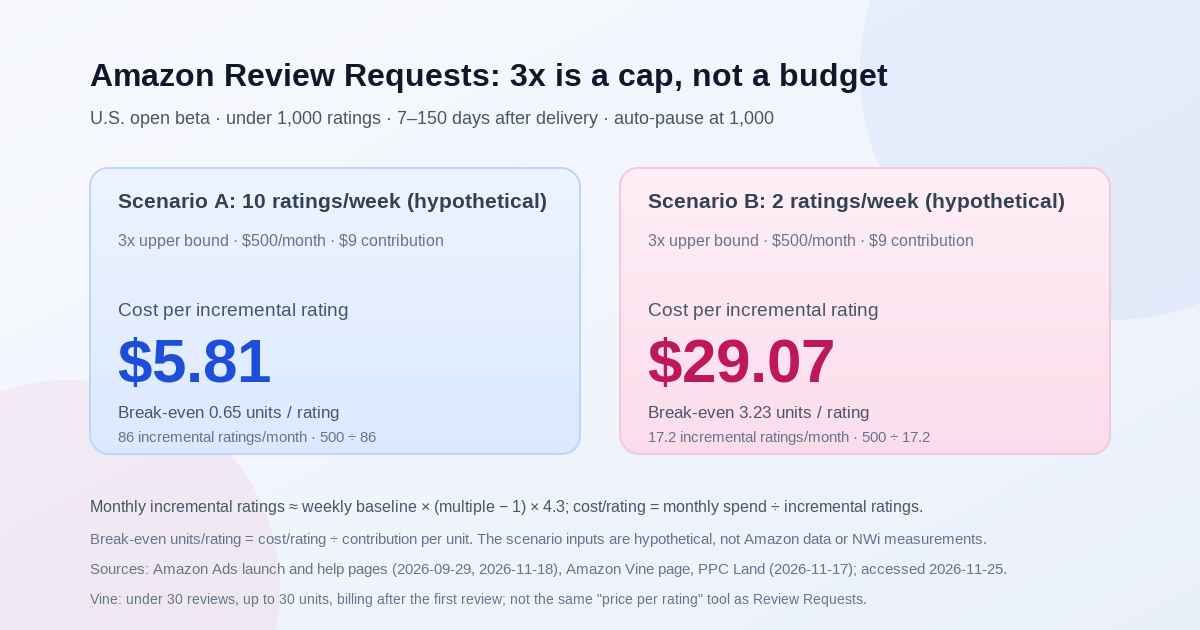
The formula is: monthly incremental ratings ≈ weekly baseline ratings × (multiple − 1) × 4.3; cost per incremental rating = monthly spend ÷ monthly incremental ratings; break-even units per rating = cost per incremental rating ÷ contribution per unit. The campaign breaks even at the contribution level only if each incremental rating drives at least that many incremental units. The formula does not depend on 3x; 3x is only an upper-bound input for incremental ratings.
3. The arithmetic: cost per rating at two review baselines
Every number below is a hypothetical example, not Amazon data or an NWi measurement. The only public inputs are Amazon's internal closed-beta 3x, which this article treats as an upper bound, and the under-1,000-ratings rule; the weekly baseline, monthly spend and unit contribution are illustrative. Replace them with your own weekly rating velocity, actual spend and contribution to recompute.
Scenario A: 10 ratings per week (hypothetical)
Assume 10 new ratings per week over the past eight weeks, a 3x upper bound after launch, $500 monthly spend and $9 contribution per unit; 4.3 weeks per month; ignore organic growth, seasonality and other review channels.
Monthly incremental ratings = 10 × (3 − 1) × 4.3 = 86; cost per incremental rating = 500 ÷ 86 = $5.81; break-even units per rating = 5.81 ÷ 9 = 0.65 units. If each new rating drives at least 0.65 incremental units, the $500 breaks even at the contribution level; if each rating is worth only $3 of contribution, $5.81 is expensive.
Run a four-week test and record ratings, spend, star rating and conversion weekly; increase budget only if the measured cost per rating is below the value you can measure per rating, or if incremental units per rating exceed 0.65.
Scenario B: 2 ratings per week (hypothetical)
Assume only 2 new ratings per week over the past eight weeks and the same other inputs as Scenario A: 3x upper bound, $500 monthly spend, $9 contribution per unit, 4.3 weeks per month.
Monthly incremental ratings = 2 × (3 − 1) × 4.3 = 17.2; cost per incremental rating = 500 ÷ 17.2 = $29.07; break-even units per rating = 29.07 ÷ 9 = 3.23 units. A low-velocity product must turn each rating into more than three incremental units to break even at the contribution level.
If the product has no stable organic rating velocity, spend first on the listing, samples and Vine (if it has fewer than 30 reviews and meets the eligibility rules); do not scale on the 3x headline. Use Review Requests only as a small-budget test of cost per rating.
Scenario C: quality risk (hypothetical)
Assume the product is at 4.5 stars but has a known defect; the campaign increases the number of ratings, not their direction.
If the defect produces 1–2 star reviews, the campaign can accelerate a rating decline; 3x counts volume, not satisfaction.
Stop immediately if the star rating falls or a negative theme repeats; fix the product and listing before resuming.
| Multiple | A: cost/rating; break-even units | B: cost/rating; break-even units |
|---|---|---|
| 1.5x | $23.26; 2.58 units | $116.28; 12.92 units |
| 2x | $11.63; 1.29 units | $58.14; 6.46 units |
| 3x | $5.81; 0.65 units | $29.07; 3.23 units |
Sensitivity: 3x is an upper bound, not a promise. At 2x, Scenario A's cost per rating rises from $5.81 to $11.63, and Scenario B's from $29.07 to $58.14. Assuming incremental ratings scale linearly with spend, at $250 monthly spend cost halves but incremental ratings also halve, so break-even units per rating is unchanged. Your baseline, actual spend, rating conversion and unit contribution change the conclusion, not the 3x headline.
4. Counter-cases: three ways to lose money
First, a low baseline. A product at 2 ratings per week gets only 17.2 incremental ratings per month at 3x, which is $29.07 per rating at $500 spend; at $9 contribution per unit, it needs 3.23 incremental units per rating. That is a high bar for low-ticket, low-repeat products.
Second, the direction of reviews is not controllable. The ad increases invitations, not positive outcomes; if the product has a defect, a sizing problem or a misleading description, the campaign can send more unhappy buyers to the review section and lower the star rating. 3x is a volume metric, not a quality metric.
Third, treating organic reviews as incremental. Many buyers would have left a review anyway; a before-and-after comparison without a control group cannot separate the ad's increment from organic growth. Amazon's 3x data is an internal closed beta over 19 days with no public control group; it does not prove your product will also see 3x.
Other explanations: the June test window may reflect seasonality, promotions or platform traffic; Review Requests reaches only recent buyers, so purchasers outside the 7–150-day window are not invited; the campaign pauses at 1,000 ratings, so it is not a long-term review-growth tool. Vine's 30-review eligibility, 30-unit cap and billing after the first review also mean it suits an earlier stage.
One more operational counter-case: if the console bills per click while the seller budgets per rating, the actual cost per rating can be far above the bid; do not treat the bid as a per-rating cap before the first invoice. Conversely, if billing is per rating, CPC is only an engagement metric, and optimising CPC may optimize the wrong target.
5. Action and stop rules: a four-week test
Build the baseline first: weekly new ratings, star distribution, conversion, return rate and unit contribution over the past 8–12 weeks; separate organic reviews, Vine reviews and Review Requests reviews. Then pick one parent ASIN, set a four-week test with a $500 total spend cap (an example, not an Amazon rule), and keep the listing, price and other ads unchanged; do not run Vine or another review campaign at the same time.
Track six fields weekly: new ratings, written reviews, average star rating, spend, CPC and cost per new rating; also watch conversion and returns to see whether ratings produce incremental sales. In week four, recompute cost per rating and break-even units per rating with actual data, then decide whether to scale, hold or stop.
| Signal | Hypothetical threshold (example) | Action |
|---|---|---|
| Cost per new rating | above the value you can measure per rating | lower the bid, cut budget or stop |
| Break-even units per rating | actual incremental units below it | stop; fix the listing/product first |
| Average star rating | down 0.2 stars or more | stop immediately; inspect 1–2 star themes |
| Written-review themes | same defect appears three times | stop; fix the product before resuming |
| Organic rating velocity | no increase over baseline after launch | move budget back to organic requests/Vine |
| 1,000-rating cap | approaching the cap | plan the exit; do not treat it as a long-term channel |
Write the stop rules before the test, not after seeing the data. These thresholds are hypothetical: a 0.2-star decline, the same defect three times, cost per rating above value per rating, or no measurable rating lift in four weeks. Stop when any one triggers; do not extend a loss with 'one more week'.
Where the tools fit: NWi CrossborderGo brings Amazon and other marketplace market, brand, store and product data into one workspace, so you can assess the price band, competitive density and brand share of the category a new ASIN is entering; site, history and field coverage depend on the contract, and it does not provide Review Requests campaign reports. If your team wants to connect back-office reports to its own analysis workflow, see MCP data access for the boundary; client compatibility, platforms, fields and permissions depend on the actual integration. To model your own category and rating baseline, use request a demo. The Amazon data-analysis method is on the Amazon data analysis page, and the product overview is NWi CrossborderGo.
6. Unknowns and limits
Five unknowns are most likely to change the conclusion: first, whether the billing unit is a rating or a click, which cannot be confirmed before the first invoice; second, your click-to-rating rate and rating-to-sales lift, which Amazon does not publish; third, we treat the 3x figure as an internal closed-beta upper bound, not your forecast; fourth, Vine's specific fee and review-disclosure requirements—this article uses the official page only for eligibility and billing timing, not a cost per rating; fifth, rating sensitivity differs by category, and this article has no category benchmark.
This article does not guarantee performance and does not recommend buying positive reviews; Review Requests only invites real purchasers to leave a rating or review. Amazon may update its pages, so verify the latest eligibility, billing and targeting in Ads Agent and the help pages before launch; NWi CrossborderGo's data scope is defined by the product page and contract, this article does not present it as a Review Requests campaign-reporting tool, and sellers should rely on their own console and invoices.
7. Method and disclosure
Data basis: the U.S. open beta, the under-1,000-ratings eligibility, the automatic pause at 1,000, the 7–150-day post-delivery targeting, the absence of manual targeting, the default bid and daily budget, and the console metrics come from Amazon Ads' 29 September 2026 launch page and two help pages whose page metadata shows a last-modified date of 26 November 2026; the 3x figure is Amazon's internal closed-beta data (U.S., 3–21 June 2026, weekly ratings and reviews combined, no control design disclosed), which this article treats as an upper bound; Vine's Professional selling plan, Brand Registry/FBA, under-30-reviews eligibility, up-to-30-unit enrollment and no charge before the first review come from Amazon's official Vine page (accessed 27 November 2026); the per-rating billing statement comes from PPC Land's report of Amazon Ads' API release note (17 November 2026), and we could not open the API page directly, so the billing unit remains an unknown to verify against the first invoice; the baseline ratings, 3x upper bound, $500 monthly spend and $9 contribution per unit in both scenarios are hypothetical examples, not Amazon data or NWi measurements.
The original increment is to split the '3x' headline into five variables—baseline, incremental ratings, cost per rating, break-even units per rating and review direction—and to treat 'per rating or per click' as a billing question to verify before launch, instead of giving a single 'should I run it' answer.
This article was prepared with automated research assistance and analysed from the public sources listed at the end; it was not manually reviewed. It does not invent customer data, expert review, sales lift, ranking results or platform endorsement. It is not legal, tax, platform-operations or investment advice.
Reference sources
- 1. Amazon Ads, 'Accelerate authentic reviews with Review Requests' (primary: U.S. open beta in late October 2026, under 1,000 ratings, 3x internal closed beta from 3–21 June 2026): view original, published 29 September 2026, accessed 27 November 2026.
- 2. Amazon Ads Help, 'Understand Review Requests' (primary page: U.S. open beta, account and product eligibility, automatic pause at 1,000 ratings, one-tap star rating with optional written review/photo/video): view original, page last modified 26 November 2026, accessed 27 November 2026.
- 3. Amazon Ads Help, 'Create a Review Requests campaign' (primary page: automatic 7–150-day post-delivery targeting, no manual targeting, default bid and daily budget, ad group structure, CPC and review metrics): view original, page last modified 26 November 2026, accessed 27 November 2026.
- 4. Amazon, 'Get customer reviews with Amazon Vine' (primary page: Professional seller, Brand Registry/generic products, FBA, under 30 reviews, up to 30 units, billing after the first review, no charge if no review within 90 days; no specific fee listed): view original, publication date not stated, accessed 27 November 2026.
- 5. PPC Land, 'Amazon sellers can pay to request reviews up to 150 days after delivery' (independent media: reports the Amazon Ads API release note's per-rating billing, the coexisting CPC metric, the 7–150-day window and the 1,000 cap; we could not open the API page directly, so the billing unit remains to be verified): view original, published 17 November 2026, accessed 27 November 2026.
- Note: the first four sources are official Amazon pages; the fifth is an independent media report of an Amazon API release note and is not an independent audit of Amazon performance data. The official pages do not independently verify seller-level results beyond the 3x figure, and this article does not extrapolate 3x to other marketplaces or an individual store.