
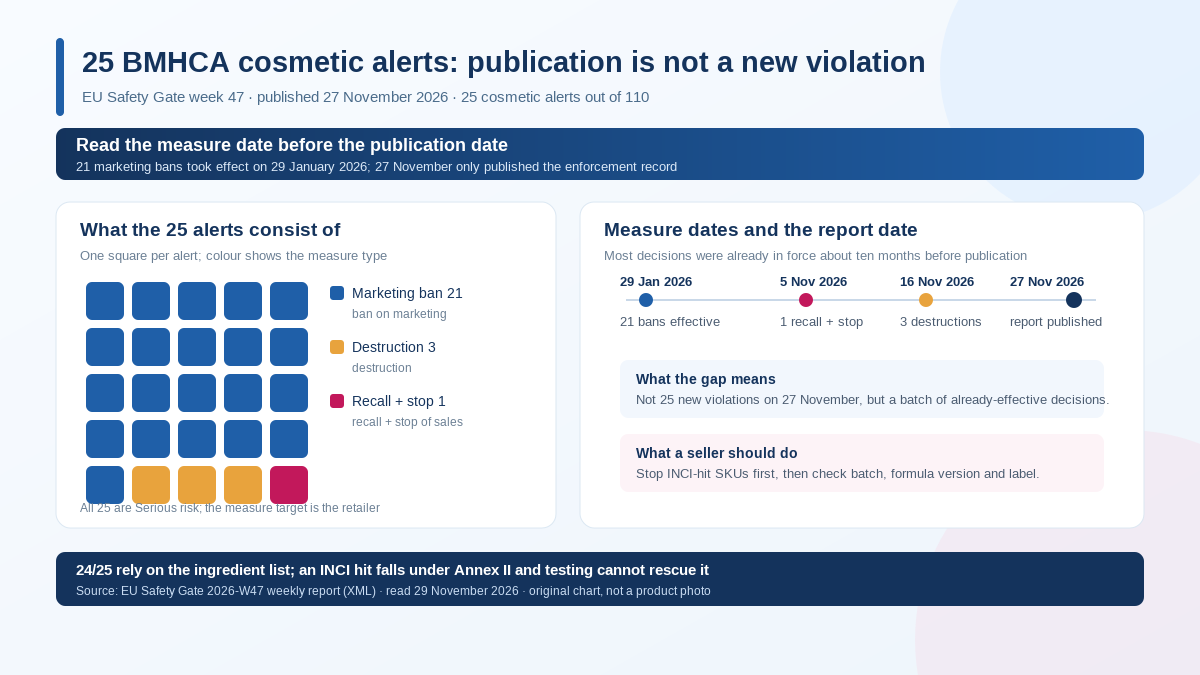
If you sell perfume, eau de toilette, shower gel, aftershave, body lotion, hand soap or face cream in the EU, the easy misreading of this batch is “25 new violations on 27 November.” That is not what happened. The EU Safety Gate week 47 report was published on 27 November 2026 and contains 25 cosmetic notifications for BMHCA (2-(4-tert-butylbenzyl)propionaldehyde, CAS 80-54-6, commonly called lilial); for 21 of them the marketing ban took effect on 29 January 2026. The first move is not testing: stop selling SKUs whose INCI lists BMHCA and check batch documents. Testing can confirm whether a batch matches its label; it cannot turn a banned ingredient into a sellable one.
The real decision is whether to stop selling EU perfume, shower gel, aftershave and face-cream SKUs whose INCI lists BMHCA and verify their batches first, or to test first and wait for results; the two sequences lead to different legal conclusions and different cash exposure.
1. What the batch contains
Report 2026-W47 has a report_date of 27 November 2026 and contains 110 notifications. Of these, 25 are cosmetic BMHCA notifications, all marked Serious risk. By notifying country: Italy 21, Czechia 3, Germany 1. By product type: perfume/eau de toilette 15, shower gel 4, aftershave 3, body lotion 1, hand soap 1, face cream 1, for 25 in total.
| Item | Count | How the source states it |
|---|---|---|
| Notifications in the week 47 report | 110 | 2026-W47, report_date 27/11/2026 |
| BMHCA cosmetic notifications | 25 | All in the Cosmetics category; all 25 are Serious risk |
| Notifying countries | Italy 21, Czechia 3, Germany 1 | notifyingCountry field |
| Product types | Perfume/eau de toilette 15, shower gel 4, aftershave 3, body lotion 1, hand soap 1, face cream 1 | 25 in total |
| Measures | Marketing ban 21, destruction 3, recall + stop of sales 1 | measure category; the measure target is the retailer in all 25 |
| Measure effective dates | 29 January 2026 (21), 16 November 2026 (3), 5 November 2026 (1) | Not the report publication date |
| Basis | 24 rely on the ingredient list; 1 also lists HICC, lead and cadmium | risk text; lead up to 38.16 mg/kg and cadmium 0.573 mg/kg apply only to that notified batch |
The measure target matters: the measure text in all 25 notifications names the retailer, not only the manufacturer. For a cross-border seller active in the EU, that means a retailer or distributor role can face a marketing ban, destruction or recall even when the seller does not own the formula.
Three records are easy to check: SR/03385/26 (Ferre shower gel, 200 ml, notified by Italy, marketing ban effective 29 January 2026), SR/03422/26 (Lancôme Hypnose Senses eau de toilette, 75 ml, France origin, notified by Italy, marketing ban effective 29 January 2026) and SR/03442/26 (Golden Pearl Beauty Cream, notified by Germany, recall plus stop of sales effective 5 November 2026). Golden Pearl is not only BMHCA: the notification also lists HICC and measured lead up to 38.16 mg/kg and cadmium 0.573 mg/kg. The first two represent the 24 ingredient-list notifications; the third shows that one batch can combine several chemical problems. These are product-level records, not a conclusion that every product from those brands is non-compliant.
The 25 notifications map to 16 named brand fields and one blank brand; that is a count of brand strings, not 16 companies, and one brand can have several products or batches. Treating a brand name as the recall scope will miss the SKUs that actually need checking.
2. The mechanism: why the ingredient list is enough
The legal chain is short. Annex II to Regulation (EC) No 1223/2009 lists substances prohibited in cosmetic products. Commission Regulation (EU) 2021/1902 added entry 1666 to Annex II for 2-(4-tert-butylbenzyl)propionaldehyde (CAS 80-54-6, EC 201-289-8) and applies from 1 March 2022. Annex II does not set a permitted concentration; that is different from a restricted substance in Annex III. The question is not whether the level is below a percentage; the substance is not allowed in a cosmetic product.
24 of the 25 risk descriptions begin with “According to the list of ingredients,” meaning the authority relied on the ingredient list/INCI; only the Golden Pearl notification also reports measured lead and cadmium. The trigger can be the label, not a laboratory test first. The direct consequence: if the INCI contains BMHCA or its chemical name, the product is already covered by the rule, and a low test result cannot make it sellable; testing is for checking whether the batch matches the label and for pursuing the supplier.
Labels and supplier files may use different strings: the chemical name 2-(4-tert-butylbenzyl)propionaldehyde, the abbreviation BMHCA, or a trade name such as Lilial in supplier documents. Screen for more than the letters “BMHCA”; use the formula, the CAS number and the regulation entry.
The measure type matters too. A marketing ban means the product cannot be sold; destruction is a direct inventory loss; a recall from end users plus a stop of sales means handling units already sold. All three appear in the 25, but the cash flow and operations are different.
3. The time gap: publication on 27 November is not a new rule
Put the dates side by side and the misreading disappears. The 25 notifications were published between 18 and 25 November 2026; the weekly report was published on 27 November; but the 21 marketing bans took effect on 29 January 2026, the three destructions on 16 November 2026 and the one recall plus stop of sales on 5 November 2026. Most enforcement decisions were already in force about ten months before the publication.
This is not “25 new violations on 27 November”; it is a batch of enforcement records collected into the week 47 report. The real question for a seller is why those products were still on the market in 2026 and were only banned in January 2026. The notification does not explain, and this article does not invent a reason. What can be confirmed is that old formulas, old batches, parallel imports or an unchanged label can keep a long-banned ingredient on a shelf; that is closer to the everyday risk than a “new rule” framing.
The right response to the report is therefore not to wait for a grace period; it is to check current stock and labels now. The regulation has applied since 1 March 2022; the 2026 enforcement simply applies it to specific products.
4. Evidence boundary: what 25 alerts can and cannot show
- What they can show: authorities enforce product by product and batch by batch, a retailer can be ordered to ban, destroy or recall, the ingredient list can be the trigger, and BMHCA can appear in perfume, shower gel, aftershave, body lotion, hand soap and face cream.
- What they cannot show: 25 is not a market failure rate; the notifications give no sales, inventory, market denominator or sample total, so they cannot support a conclusion about a country, brand or platform's overall compliance.
- What they cannot show: 24 alerts rely on the ingredient list, which does not mean the other one was fully tested; the Golden Pearl lead and cadmium values apply only to that notified product and batch, not to other creams.
- What they cannot show: Italy notified 21 of the 25, which does not make Italy the only enforcing country or the market with the most problems; it may reflect notification timing, enforcement concentration or submission timing, and the report does not explain it.
- What they cannot show: the notifications do not say whether your store or listing is affected; in the four detail records checked, the online-sale field was Unknown or No and there was no platform link, so it cannot be read as “not sold online” or “safe online.”
- What they cannot show: not appearing in these 25 does not prove compliance; the report is a set of published cases, not a complete inventory.
These limits mean the article cannot give you a “25 out of how many” failure rate or say that a brand is wholly non-compliant. What it can give you is a checking order and stop conditions.
5. Counter-cases: where the judgment can go wrong
- Parallel imports or leftover stock: the brand may not control the notified batch, but the retailer is still responsible for what it sells and cannot push all responsibility upstream.
- Counterfeits: the isCounterfeit field was Unknown in the checked sample, so counterfeiting is not the default explanation; if a unit is confirmed counterfeit, that still does not prove the brand's official product contains BMHCA.
- A reformulated product: an old batch being notified does not mean the new formula still contains BMHCA, but the new formula needs a formula-version date, batch records and label consistency, not just a supplier's verbal assurance.
- A label error: an INCI that lists BMHCA may be a labeling error rather than the actual formula, but the operator carries the burden of proof, and until batch files and a correction record exist the product should be treated as high risk.
- Multiple substances at once: Golden Pearl also lists HICC, lead and cadmium; focusing only on a fragrance allergen misses the heavy-metal and pigment/talc contamination routes.
These counter-cases are not reasons to keep selling; they decide which batch you stop first and which document you request first. Only a supplier that can align the batch, the formula version and the label belongs in a relisting discussion.
6. Reproducible scenario A: 40 SKUs, 6 INCI hits
Scenario A: 40 SKUs, 6 INCI hits, 300 units per SKU. Assumptions: all six SKUs list BMHCA in the INCI; 300 units per SKU at EUR 12 cost and EUR 35 retail; testing at EUR 250–600 per SKU including courier and admin; no substitution sales, returns, label correction or platform grace period.
Result: inventory cost for six SKUs = 6 × 300 × 12 = EUR 21,600; testing all six = 6 × 250 to 6 × 600 = EUR 1,500–3,600; if four SKUs are shown to be label errors and can be relisted, recovered inventory = 4 × 300 × 12 = EUR 14,400, the remaining two are written off at 2 × 300 × 12 = EUR 7,200, and testing plus write-off = EUR 8,700–10,800; if all six are confirmed to contain BMHCA, the full EUR 21,600 is unsellable.
Against a recall cost of EUR 23,400, the EUR 8,700–10,800 testing-plus-write-off is 37.2%–46.2%; that ratio holds only under these assumptions and does not change the legal status of a banned substance.
Decision: stop selling the six INCI-hit SKUs first, then decide whether to run batch checks for a label error; do not keep selling while waiting for tests; if 600 units have already been sold and a recall follows, refunds at EUR 35 = EUR 21,000 plus reverse logistics at EUR 4 per unit = EUR 2,400, or EUR 23,400 before fines.
7. Reproducible scenario B: 300 SKUs, 60 fragrance and body-care SKUs
Scenario B: 300 SKUs, 60 fragrance and body-care SKUs, 200 units per SKU. Assumptions: full INCI screening of 300 SKUs at 10 minutes each = 3,000 minutes = 50 hours at EUR 25 per hour = EUR 1,250; eight SKUs need batch files and testing after screening; 200 units per SKU at EUR 9 cost; testing at EUR 250–600 per SKU; no lost sales or substitution during the stop-sale period.
Result: stopping all 60 SKUs freezes 60 × 200 × 9 = EUR 108,000 of inventory; testing all 60 = 60 × 250 to 60 × 600 = EUR 15,000–36,000; after the two-layer screen, eight SKUs freeze 8 × 200 × 9 = EUR 14,400, testing = 8 × 250 to 8 × 600 = EUR 2,000–4,800, and screening plus testing cash outlay = EUR 3,250–6,050; frozen inventory is EUR 93,600 lower and testing spend is EUR 13,000–31,200 lower, before the EUR 1,250 screening cost.
Decision: when suppliers can provide batch CoA, formula version and PIF/CPSR, use the two-layer screen to cut the stop-sale set from 60 SKUs to eight; when they can only provide a generic “REACH compliant” letter or no batch file, treat all 60 as high risk; if the file does not match the batch, the formula version and the label, do not relist.
Put the two scenarios together: Scenario A's EUR 21,600 inventory, EUR 1,500–3,600 testing and EUR 7,200 write-off cover six INCI-hit SKUs; Scenario B's EUR 108,000 stop-all exposure versus EUR 14,400 after the two-layer screen and EUR 3,250–6,050 cash outlay cover 60 of 300 fragrance and body-care SKUs.
8. Action list and stop conditions
- Build the table: SKU × market × product type × INCI × batch × production date × label version × supplier. Start with EU SKUs and do not mix in UK or other market rules.
- Screen the INCI for the chemical name, BMHCA and CAS 80-54-6, not just a trade name. On a hit, stop sales and keep the listing screenshot, batch, label and purchase record.
- Request documents: full INCI, formula-version date, batch CoA, PIF/CPSR and a cosmetics/REACH declaration that maps to the specific batch, not a generic certificate.
- Triage: INCI hit and batch confirmed to contain BMHCA → stop sale, return or destroy; INCI hit but a documented label error and a BMHCA-free batch → correct the label and keep the evidence before considering relisting; no INCI hit but high supplier risk → test or request a CoA, ranked by revenue and volume.
- Stop conditions: no batch-level file; a formula-version date before 1 March 2022 with no update evidence; BMHCA still in the INCI; a supplier that only offers a generic “REACH compliant” letter; a label that does not match the batch. Any one of these means no relisting.
- Do not: use “low concentration,” “rinse-off” or “natural fragrance” as a reason to keep selling; assume a similar product is safe because a big brand also appears in the alerts; wait for a platform takedown before acting.
The sequence is to build a SKU × INCI × batch table, stop sales on any hit, ask suppliers for batch CoA, formula version and PIF/CPSR, and relist only when the batch, the formula version and the label agree; if they do not, keep the product stopped.
9. What this means for selection and data
The effect on selection is not “the EU has banned perfume.” It is “a perfume whose ingredients and batch cannot be evidenced cannot be sold.” Compliance evidence belongs in SKU admission, not in after-sales repair. Data helps rank exposure: which categories, price bands, brands and stores carry the most revenue and stock, and which SKUs to audit first. Data cannot prove a SKU is safe, and it does not replace the INCI, the CoA and the regulation.
Within activated modules, NWi CrossborderGo provides platform, country/region, category, brand, store and product data, including sales, units, ASP, brand share and price bands; prior-month data is updated between the 10th and 15th of each month, and available sites, history and fields depend on the contract. It can help size a category and rank price bands and brand concentration in activated markets so a team can decide which SKUs to audit first; it does not provide product testing, ingredient review, PIF/CPSR, recall handling or legal advice.
To size a category, its price bands and brand concentration in activated markets, see NWi CrossborderGo; to bring SKU and stock checks into operations, see NWi Operations; to break the data down by site, category and brand, book a demo. Product capabilities, site coverage and fields depend on the modules activated and the contract.
10. Method and disclosure
Data basis: on 29 November 2026 this article reopened the EU Safety Gate week 47 weekly report XML (report_date 27/11/2026, 2026-W47, 110 notifications) and parsed the 25 BMHCA cosmetic notifications one by one, checking notifying country, country of origin, product type, measure category, measure effective date, risk level and the risk text. It also opened the detail records SR/03385/26, SR/03422/26, SR/03442/26 and SR/03409/26 to check brand, product size, measure target, online-sale flag and measure date. The legal basis comes from Commission Regulation (EU) 2021/1902 on EUR-Lex (adopted 29 October 2021, published 3 November 2021, applicable from 1 March 2022): it added entry 1666 to Annex II of Regulation (EC) No 1223/2009 for 2-(4-tert-butylbenzyl)propionaldehyde (CAS 80-54-6, EC 201-289-8). Calculation basis: Scenario A uses 40 SKUs, 6 INCI hits, 300 units per SKU, EUR 12 cost, EUR 35 retail and EUR 250–600 testing per SKU. Scenario B uses 300 SKUs, 60 fragrance and body-care SKUs, 200 units per SKU, EUR 9 cost, 300 × 10 minutes of screening at EUR 25 per hour, and EUR 250–600 testing per SKU. All SKU counts, stock, prices, test fees, hours and recall logistics costs are labeled assumptions, not measurements by the EU, Safety Gate, NWi or any seller; the notifications do not provide sales, inventory, a market denominator or platform links.
This article was prepared with automated research assistance and is based on the public sources listed at the end; it was not reviewed by a human expert. It does not invent customer data, expert review, sales, test results, platform review outcomes or ranking effects. It is not legal, compliance, product-safety or marketplace-operations advice; whether a product contains BMHCA, whether it should be stopped or recalled, which market rule applies, and how to prepare a PIF/CPSR or engage a competent authority should be confirmed against the latest regulation, an accredited testing body, the competent authority and the actual product batch.
This article has no seller SKU list, stock, sales, test reports or marketplace back-end data, and it did not read the consolidated text of Regulation (EC) No 1223/2009; test fees, stock, retail prices, hours and recall logistics costs are labeled assumptions, and the notifications do not provide sales, a market denominator or online listing links.
11. Conclusion
Three sentences: first, 27 November is the report publication date, not the effective date of a new rule; the 21 marketing bans had already taken effect on 29 January 2026. Second, a BMHCA entry in the INCI falls under Annex II, and testing cannot make it sellable; testing can only check the batch and support recourse. Third, screen SKUs by INCI and batch files first, then rank by revenue and stock; if the files do not align, do not relist.
The contribution is threefold: splitting the 25 alerts into measure type, effective date and evidence type; separating a label hit from a test hit to explain why testing cannot rescue the product; and using two reproducible scenarios to quantify the stop-sale set, testing cost and inventory exposure.
Sources
- European Commission – Safety Gate, 27 November 2026, Weekly report 2026-W47 (XML): report_date 27/11/2026; 110 notifications, of which 25 are BMHCA cosmetics; used for the notification-country, product-type, measure, effective-date, risk-level and risk-text counts; reopened and parsed on 29 November 2026.
- European Commission – Safety Gate, 19 November 2026, SR/03385/26 Ferre shower gel: Ferre shower gel, 200 ml; notified by Italy; the ingredient list contains BMHCA; retailer marketing ban; effective 29 January 2026; online-sale flag Unknown; read on 29 November 2026.
- European Commission – Safety Gate, 24 November 2026, SR/03422/26 Lancôme Hypnose Senses: Lancôme Hypnose Senses eau de toilette, 75 ml; France origin; notified by Italy; the ingredient list contains BMHCA; retailer marketing ban; effective 29 January 2026; read on 29 November 2026.
- European Commission – Safety Gate, 25 November 2026, SR/03442/26 Golden Pearl skin cream: Golden Pearl Beauty Cream; Pakistan origin; notified by Germany; BMHCA plus HICC, lead up to 38.16 mg/kg and cadmium 0.573 mg/kg; recall plus stop of sales; effective 5 November 2026; online-sale flag No; read on 29 November 2026.
- European Commission – Safety Gate, 24 November 2026, SR/03409/26 NG eau de toilette: NG ACQUA CALMA eau de toilette, 100 ml; Netherlands origin; notified by Czechia; the ingredient list contains BMHCA; destruction; effective 16 November 2026; read on 29 November 2026.
- Official Journal of the European Union / EUR-Lex, published 3 November 2021, Commission Regulation (EU) 2021/1902: added entry 1666 to Annex II of Regulation (EC) No 1223/2009 for 2-(4-tert-butylbenzyl)propionaldehyde (CAS 80-54-6, EC 201-289-8); applicable from 1 March 2022; read on 29 November 2026.