
For cross-border sellers already running on Amazon or Shopee and weighing Latin America as their next growth market, the real question is whether to enter Mercado Libre Brazil or Mexico first, and which price band and listing type will keep unit contribution positive. Only after you separate platform-wide GMV, unit and buyer growth from demand in your own category, and rebuild unit contribution with the fees that actually apply to you, should you commit to enter or expand.
1. Platform fundamentals first: how big Mercado Libre is, and where growth comes from
Mercado Libre (NASDAQ: MELI) runs e-commerce alongside its Mercado Pago financial business in Brazil, Mexico, Argentina and other major Latin American markets. Its Q3 2026 official results were published on 4 November, and the figures below cover the three months to 30 September. Company net revenue or GMV is not the same thing as the total e-commerce market of any single Latin American country:
- Net revenue and financial income of USD 10.75 billion, up 45% year over year
- GMV of about USD 23 billion, up 33% at constant currency and 38% in US dollars
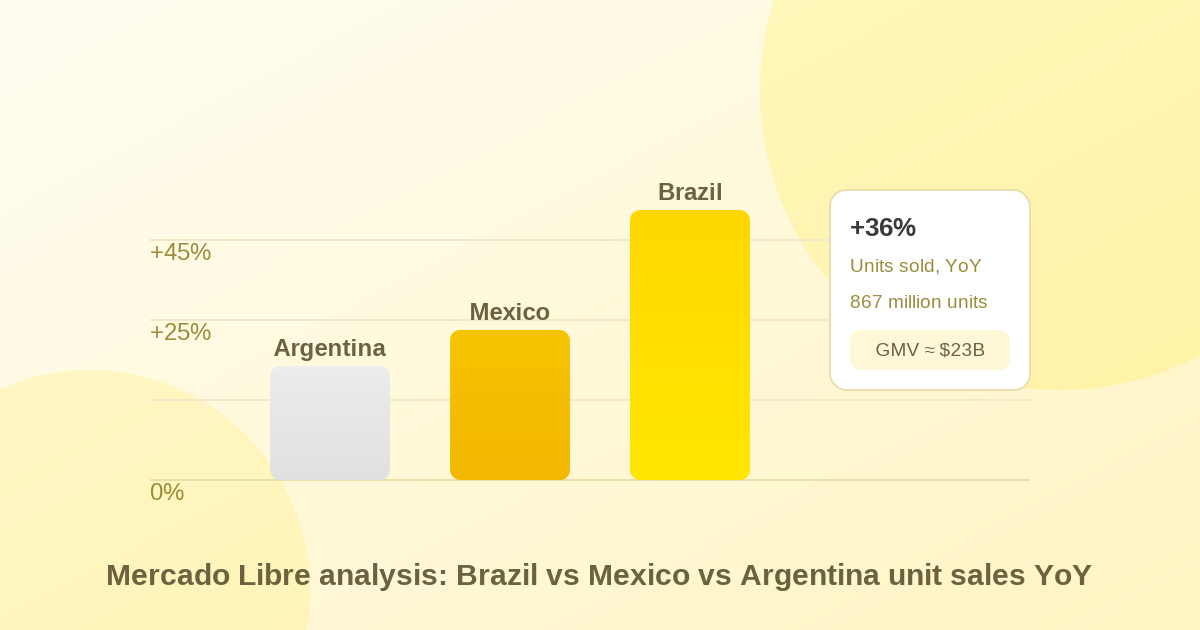
- 867 million units sold, up 36% year over year
- About 94 million active e-commerce buyers, up 22% year over year
- Brazil: units +45% and GMV +36% at constant currency; the company calls it the fifth consecutive quarter of unit growth above 40%
- Mexico: units +25%, GMV +21% at constant currency and buyers +21%; the company describes the consumer environment as softer
- Argentina: units +19% and GMV +40% at constant currency; the company describes a weak retail environment but record purchase frequency
- Units per buyer up 12% year over year, including 16% in Brazil
The company also reports e-commerce net revenue of USD 6.1 billion (+47% in US dollars), operating income of USD 676 million (a 6.3% margin), net income of USD 448 million (a 4.2% margin), fulfillment capacity up nearly 20% quarter over quarter, and 79% of fast fulfillment delivered within 48 hours. GMV is the total value of goods transacted on the marketplace; net revenue is the revenue the company recognizes. The two are different measures. Sellers cannot use platform GMV to estimate their own sales, and certainly cannot treat the USD 10.75 billion of net revenue as the size of the whole Latin American e-commerce market.
2. Read the definitions: why GMV growth is not demand in your category
Platform GMV and unit growth are driven by total buyers, purchase frequency and average unit price, and have nothing to do with supply and demand in your specific category. The company reports units per buyer up 12% year over year and 16% in Brazil, which means part of the growth comes from existing buyers buying more, not from every category expanding proportionally. Before entering, break platform growth into search, supply and price-band changes in your target category, and do not use platform growth rates directly as a product-selection signal.
Financial results can describe the operating backdrop of the company and its segments, but they cannot prove that unmet demand exists in your specific category, and mixing constant-currency figures with US-dollar figures will overstate or understate the effect of exchange rates on revenue. For sellers who report in US dollars or renminbi, constant-currency growth is the better gauge of local demand momentum, while US-dollar growth also contains currency movements; read both, and label the base and the currency each time.
3. The official data tools: Competencia approximations and the revenue calculator
According to Mercado Libre’s seller learning center guide “Know your competition and improve the management of your business”, the Competencia section of the seller back office provides two rankings for each category and subcategory: the metrics of the best sellers, and the aggregate metrics of the 10 sellers near your position. You can also compare yourself with any competitor and see the quality, shopping experience and “approximate sales and conversion figures” for up to 50 of their listings. The company states explicitly that, for privacy reasons, seller and competitor names are replaced with aliases, and that the numbers and percentages shown are approximations.
That makes Competencia a good tool for observing rankings and relative position, and a poor tool for treating “approximate sales” as real transactions to back out purchase volumes. The official pricing page also offers a revenue calculator that estimates per-order revenue by country, delivery method and fees. Use the two together: define the category and competitors in Competencia first, then run unit contribution through the revenue calculator and your own cost sheet.
4. Fee structure: commission, low-price fixed fee and storage
The fees below come from the Mercado Libre Global Selling pricing page, accessed on 2026-11-28. Listing is free and commission is charged on the sale price only after an order is completed. Brazil lists 12.5% per order for Classic listings and 16.5% per order for Premium listings; Mexico, Chile and Colombia vary by category; Argentina is marked TBD. Brazil’s rates cannot be applied to every cross-border seller in every other country:
- Listing is free; commission is charged on the sale price (not the list price) after an order is completed
- Brazil: 12.5% per order for Classic listings and 16.5% per order for Premium listings
- Mexico, Chile and Colombia: rates vary by category; Argentina: marked TBD
- Low-priced items also carry a per-unit fixed fee: MXN 33 in Mexico (≤ MXN 299), BRL 9.6 in Brazil (≤ BRL 79), CLP 1,650 in Chile (≤ CLP 15,650) and COP 7,200 in Colombia (≤ COP 60,000)
- Minimum listing price: from about USD 3 in direct-shipping mode (USD 13 in Argentina), and USD 4 in some countries in Full mode
- Delivery is a mandatory fee, calculated from reputation, origin or destination and delivery method
- Long-term storage fees start once inventory exceeds 60 days and scale with volume and age
5. Turn the profit question into a unit-contribution model you can recompute
All operating inputs below are hypothetical examples in Brazilian reais (BRL); they are not Mercado Libre averages, recommended prices or real merchant results. The denominator is a single-unit order from the same month that was not returned and has completed settlement. Revenue P is the unit revenue for the retained item after discounts and after cancellations and refunds; commission is calculated on the sale price P; the return loss R includes only the unrecoverable goods value, reverse freight and non-refundable fees not already counted elsewhere, because refunds are already excluded from revenue and must not be deducted twice.
Unit contribution M = P − C − K − F − L − R, where P is the sale price, C is the purchase cost of goods, K is commission, F is the low-price fixed fee (charged when the sale price is below the threshold), L is delivery and R is the additional return loss. Purchase cost C must be included, or gross margin will be mistaken for net profit.
Scenario A: a mid-priced item in Brazil
Assume a sale price P = 120, purchase cost C = 45, a 12.5% Classic commission (K = 15), a sale price at or above BRL 79 so F = 0, delivery L = 18 and a return loss R = 3.
Unit contribution = 120 − 45 − 15 − 0 − 18 − 3 = 39 BRL, a 32.5% contribution rate. If the seller sets a floor of 25 BRL of contribution per unit, Scenario A clears it and can be a candidate for the mid-price band in Brazil.
Scenario B: a low-priced item in Brazil
Assume a sale price P = 60, purchase cost C = 22, a 12.5% Classic commission (K = 7.5), a sale price below BRL 79 so F = 9.6, delivery L = 10 and a return loss R = 2.
Unit contribution = 60 − 22 − 7.5 − 9.6 − 10 − 2 = 8.9 BRL, a 14.8% contribution rate. Without the fixed fee it would be 18.5 BRL (30.8%); the 9.6 BRL fixed fee is 16% of the sale price and cuts the contribution rate by 16 percentage points. Low-priced items must carry the fixed fee as a separate line, or profit will be overstated.
The fixed fee is an absolute amount per unit, so it erodes low-priced items far more than high-priced ones. In this example the 9.6 BRL fixed fee is about 16% of a 60 BRL sale price, but 0% of a 120 BRL sale price, because Scenario A does not trigger it.
Sensitivity: every additional 1 BRL of delivery cost L reduces unit contribution by 1 BRL. In Scenario B, if L rises from 10 to 15, unit contribution falls from 8.9 to 3.9 BRL; above roughly 18.9 BRL of L, unit contribution turns negative. Profit in the low-price band is especially sensitive to delivery and purchase cost, so confirm the range of both before entering rather than modeling a single point.
6. Market selection and validation: what to record, and when to continue or stop
Start by building a record for one SKU grouped by order date that keeps the marketplace, category, list price, sale price, commission rate, low-price fixed fee, delivery fee, purchase cost of goods, return loss, payout date and exchange rate. Use the Competencia rankings to define what to watch, check fees with the revenue calculator, then compare your own invoices with the model; commission, fixed fees and delivery are all governed by the actual invoice.
Continue when mature orders, recomputed on actual fees, meet your contribution target and search and price-band data in the target category support the existence of demand; adjust when contribution is positive but below target, checking first whether the low-price fixed fee was omitted and whether the delivery method can be cheaper before raising price or changing category; stop when recomputed unit contribution turns negative, or when you cannot confirm your contracting entity, taxes and payout obligations in the target country — fill those gaps before deciding.
An easy misjudgment is to enter while platform GMV is growing fast, only to run into a price war or oversupply in your own category. Brazil’s +45% unit growth is platform-wide and does not mean your category is expanding. Mexico’s +25% unit growth, alongside the company’s description of a softer consumer environment, does not mean every category has slowed either. Compare competitor counts, price bands and unit changes in your target category before drawing a conclusion, and do not treat a single platform number as the whole picture.
7. Limitations and uncertainty
The unknowns most likely to change the conclusion are real demand and competition in your own category, the category-specific commission rates in Mexico, Chile and Colombia, and the actual basis on which delivery fees are calculated. This article only reads the public rates and financial summary on the official pricing page; it does not enter the seller back office to verify which fields Competencia actually shows or the range of its approximation error. Recompute once you have your own account, category rates and mature sales data.
This article discusses Mercado Libre’s public research methods. NWi CrossborderGo’s published coverage lists Mercado Libre Brazil and Mexico as monthly market-data options covering category, brand and product dimensions; available sites, history and fields depend on activation and the contract. This article does not claim real-time sales, store-level settlement data or seller back-office access. Nor does it mean that the same fees and eligibility requirements apply to every cross-border seller; the official contracting terms of the target country govern. To connect market data with your own cost sheet in a repeatable reconciliation, request a demo.
Method and notes
Data definitions in this article: platform financial and operating metrics come from Mercado Libre’s Q3 2026 official results, fees from the Global Selling pricing page and the seller-tool description from the Seller Learning Centre (all re-read on 28 November 2026; the old trailing-slash learning-centre URL now redirects to the seller hub, so the working no-slash URL is cited); the article separates GMV from net revenue, constant-currency from US-dollar figures, and actual own-store transactions from official approximations. All operating calculations in the text are hypothetical examples.
If you already have a product but have not chosen a first marketplace, see “Already Have Inventory but Not Sure Which Country to Enter First? Use a Data Matrix to Find Your Best Launch Market” and “Going Global in Southeast Asia: How to Choose Your First Market?”; for price-band risk in the low-price range, see “How to Avoid ‘Price Traps’ in Cross-Border Product Selection”; for the same method applied to another marketplace, see “Coupang Data Analysis”.
Sources
- 1. Mercado Libre News, “Mercado Libre Revenue Reaches $10.75 billion in Q3 2026, up 45% year over year” (primary source, published 2026-11-04): read the original, accessed 28 November 2026
- 2. Mercado Libre Global Selling, “Pricing and Fee Structure” (primary source): read the original, accessed 28 November 2026
- 3. Mercado Libre Seller Learning Centre, “Know your competition and improve the management of your business” (primary source): read the original, accessed 28 November 2026
This article was prepared with automated research assistance and analysed from the public sources listed at the end; it was not manually reviewed. It does not invent customer data, expert review, sales lift, ranking results or platform endorsement. It is not financial, tax, legal or operational advice; questions about platform rates, seller eligibility, settlement and contract terms should be checked against Mercado Libre’s seller centre, the contract and the back-office statement.